
Need this roof reviewed?
Built-up (BUR) roof repair, recoating, and replacement in Hollywood, FL, with ply and moisture assessment, flashing review, and clear records for managers.
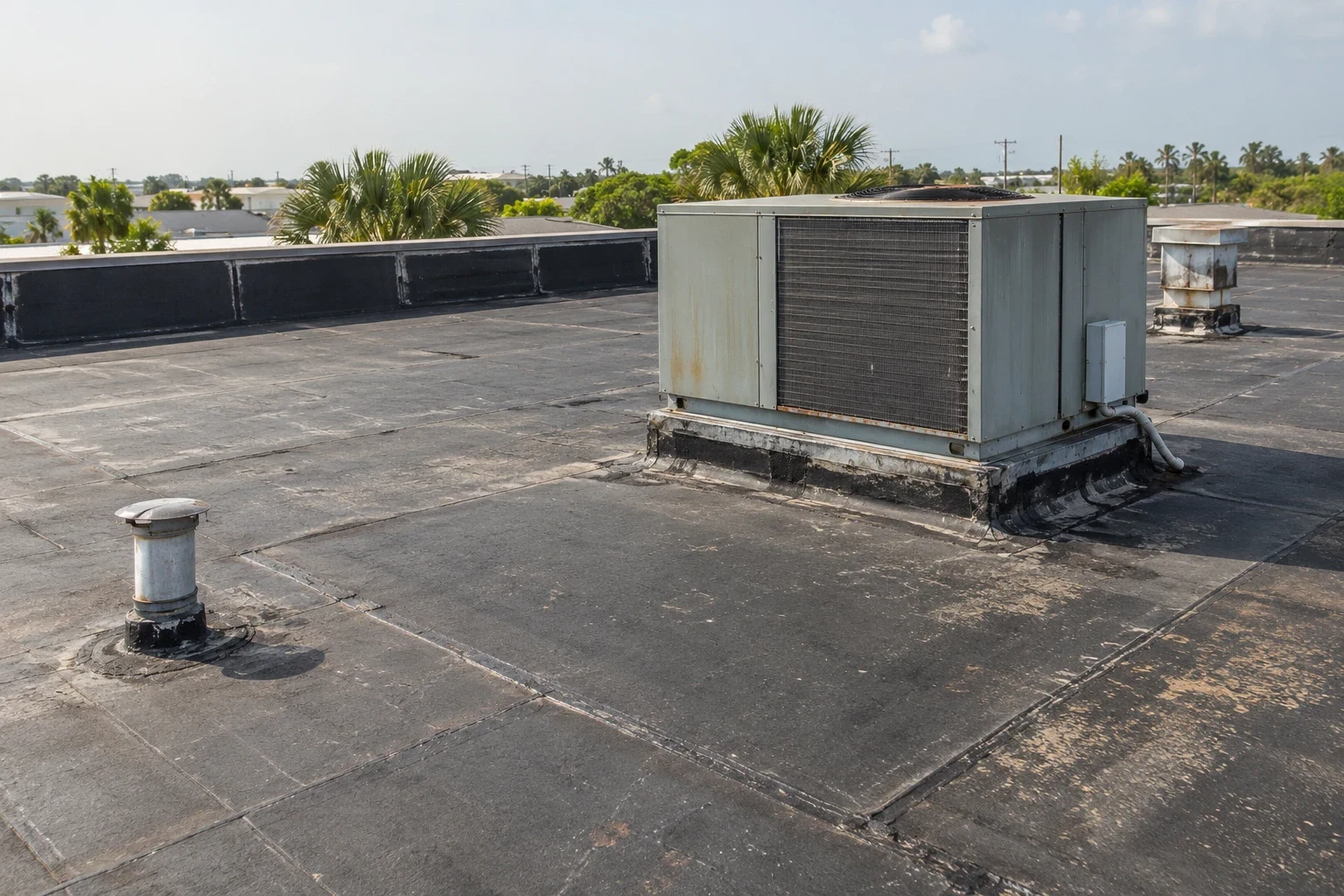
Bare felt showing through gravel is the first thing to look for on a built-up roof. The surfacing protects the asphalt and the plies below from sun, and when it thins or washes toward a drain, the asphalt ages faster and the felts begin to take on water. A built-up roof is a stack: alternating layers of felt and bitumen, topped with gravel or a cap sheet, and each layer has a story. In Hollywood, FL, long summer heat and a heavy wet season work on that stack from above, so we read the surface first and then test downward. The result is a written map of what is sound, what is wet and what has aged out, written for a manager who has to choose between patching, coating and replacement.
Walking a gravel roof also tells us about drainage: stone pushed into a long line marks where water has run.
Plies, bitumen, and surfacing
A conventional built-up roof has several plies of reinforcing felt, each mopped with hot asphalt, then a surface of gravel in a flood coat or a mineral cap sheet. The layers act together: bitumen waterproofs, felts reinforce and the surface shields. A weakness in one layer shifts the load to the others.
We identify the number of plies by sampling where the owner allows it, and we note whether the surface is gravel, a smooth coating or a cap sheet. Gravel that has migrated, thin spots at the high points and bare areas near drains are mapped. Each affects the repair choice. A roof with a healthy surface and local damage differs from a roof whose surface is gone across a whole section.
Tar and gravel roofs also carry weight, and a replacement that changes the system changes the load on the deck. We confirm what the structure supports before recommending a heavier or lighter assembly.
Alligatoring, splits, and exposed felts
Aging asphalt cracks in a pattern that looks like reptile skin, which is why the condition is called alligatoring. It starts at the surface and deepens as sunlight and heat cycles continue. Splits can also appear along felt edges or over insulation joints, where movement concentrates.
August afternoons average 89.9°F at the NOAA Hollywood station, and bitumen on a roof surface runs hotter still. We look at how deep the cracking goes and whether the felts are exposed. Surface cracking alone may be addressed by coating. Exposed felts, open splits and soft spots call for patching with new plies tied into the old, and widespread exposure moves the discussion toward replacement.
Gravel, flood coats, and drain protection
Gravel does more than protect. It also holds the roof in place against wind scour and keeps sunlight off the bitumen. When wind or heavy rain pushes gravel into drains and gutters, the roof loses its shield and the drains lose capacity. We check each drain for stone and debris and restore the flood coat or gravel where it has thinned.
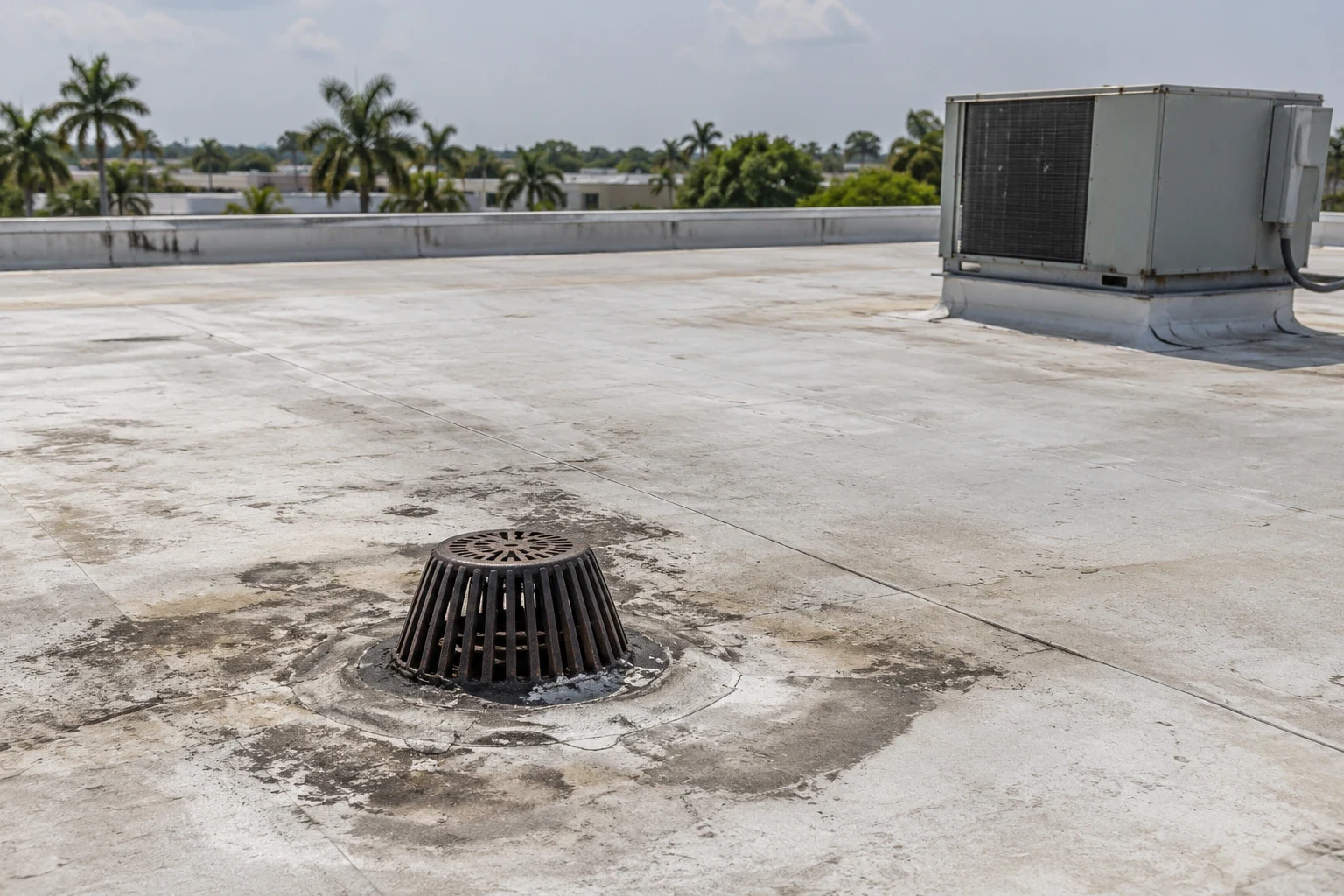
Roof drains on a built-up roof often sit in a sump with a flashing ring that must remain sealed. We inspect those rings, strainers and leaders, and we look for ponding in the area around them. A roof drain and scupper that is partly blocked can hold water over a spot that was never designed for it, and standing water accelerates blistering and deterioration of the plies beneath.
After storms, gravel is re-spread where it has moved, because bare spots at the high points are where sun and rain do the most damage first.
Drain rings are re-sealed where the flashing has pulled from the sump.
Flashings, expansion joints, and edges
Where a built-up roof meets a wall, a curb or an expansion joint, flashing carries the load. Base flashings made of felt and asphalt can split with movement, and counterflashing can pull away. Edge metal and gravel stops hold the roof's perimeter, and a loosened joint lets rain get behind the membrane.
We inspect every transition and compare the interior marks with the roof layout. A stain in a corridor ceiling may come from a wall flashing several feet away. In the Historic Hollywood Business District, where the original 1921 layout combined residential, business and recreational spaces, each flashing is checked against what is actually installed, whatever the building's era.
Expansion joints get a separate look, since a joint cover that has hardened or shifted can open a straight path for water through the building's thermal movement line.
Hot asphalt, odor, and delivery planning
Traditional built-up work uses hot asphalt, which means a kettle or tanker, hoses, fire watch and an odor that carries. Cold-applied built-up systems avoid some of that, and the choice depends on the building, its neighbors and its air intakes.
Event days downtown can limit kettle and material deliveries, so for a project near Downtown Hollywood we check the Hollywood Boulevard calendar before booking. The fire plan, permit and intake protection are agreed with the owner in advance, and tenants receive notice of the work days and the likely odor.
Moisture in a multi-ply assembly
A multi-ply roof can hold water between layers and show it only after a long delay. Interior stains may lag behind a break by months. Moisture mapping, infrared moisture survey where conditions permit and core samples where they do not show which plies are wet, and wet areas are marked on the roof sketch.
The wet-area map decides the scope. Small wet zones can be cut out and replaced with new plies. Large wet zones, or wet insulation under dry felts, suggest tear-off. Because September rainfall averages 8.67 inches at Hollywood, a roof that was dry in spring may be tested hard by late summer, and we recommend a follow-up walk after the first wet stretch.
Repair, coating, or replacement
Isolated splits and flashing defects over dry plies call for repair. A sound roof with a worn surface may take a coating. Widespread alligatoring, exposed felts or wet insulation points toward replacement of that section with a modified bitumen roof or a single-ply system. Expect the price to move with tear-off depth, insulation, penetration count and access constraints.
A TPO roof or a rubber membrane can replace a built-up section when weight, access or budget favors a single-ply system, and we price the same section each way so the comparison is based on one set of readings.
The closeout record names plies added, products used, moisture readings, photographs and the date a follow-up walk is due. A roof that has been mapped once is far easier to manage than one that has only been patched.