Need this roof reviewed?
TPO roof installation, repair, and evaluation in Hollywood, FL, with weld testing, flashing review, drainage checks, and a record of observed conditions.
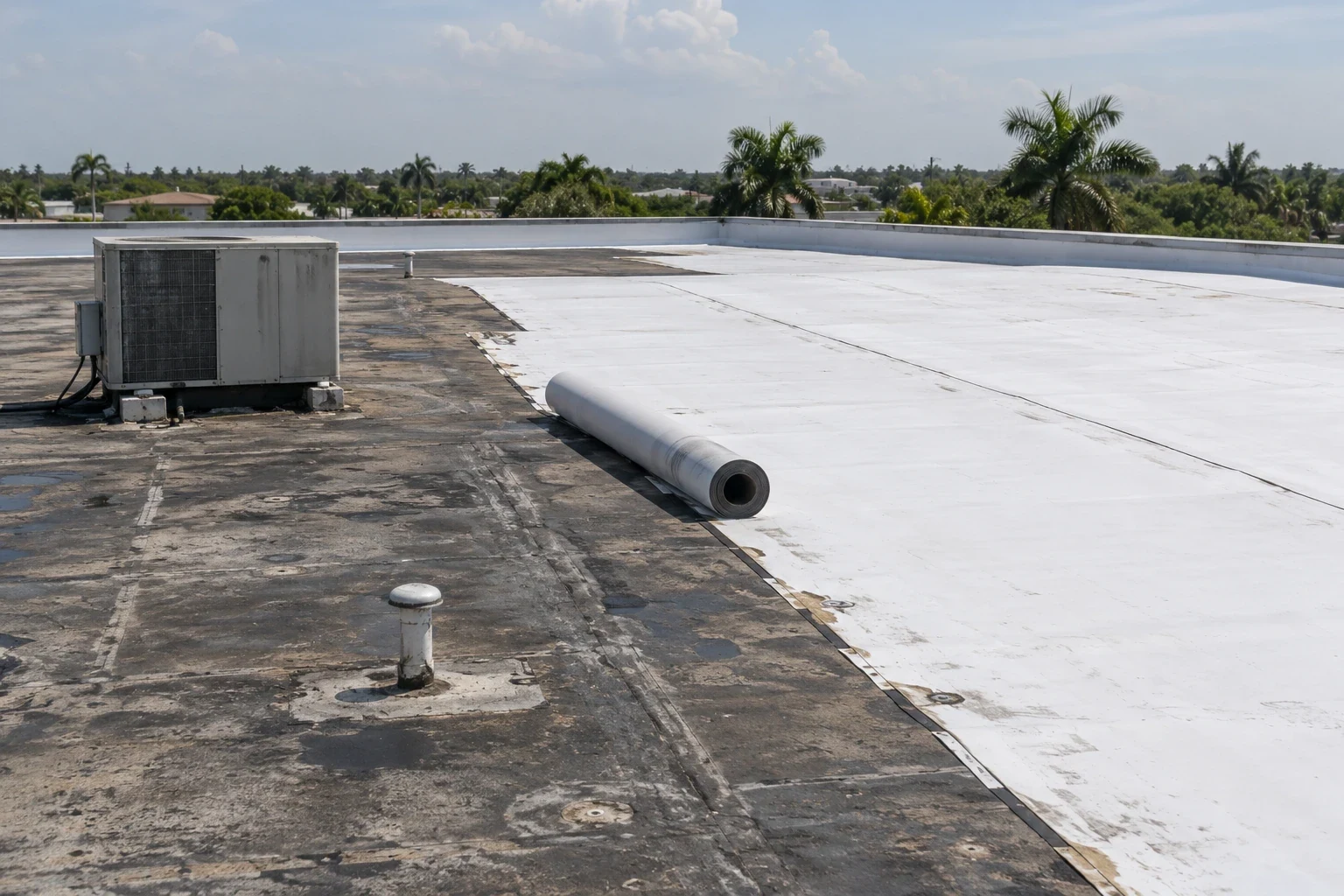
A white TPO roof can look clean and bright from the parking lot while a heat-welded seam has started to lift at one corner. The surface temperature of that sheet climbs every summer afternoon, then drops sharply when a storm moves through, and the weld takes the movement. In Hollywood, FL, that daily swing meets a long wet season, so the first question is not the age of the roof but the condition of its seams, flashings and drains. We walk the sheet, probe the welds, photograph every transition and trace the likely water path before recommending anything. The property manager receives a record tied to locations on the roof, so repair, monitoring or replacement can be chosen from observed conditions.
Heat path and thermal movement
August afternoons at the NOAA Hollywood station average 89.9°F, with the roof surface itself running well above the air. A reflective TPO sheet reduces the heat it absorbs, but it still expands in the afternoon and contracts overnight, and the movement concentrates where the membrane is restrained: at curbs, drains, parapets and fastener lines.
That is why we read the heat path at details and not only across the field. A weld that was made on a cool morning behaves differently from one made in the afternoon sun, and a membrane that was stretched over a curb can pull its flashing away years later. We look for shrinkage at inside corners, wrinkling at edges and dirt streaks that show where water has been standing.
On a recently cleaned roof the first sign of heat stress is often at the edges, where thin metal expands faster than the membrane beside it. We check the termination at every edge and the fasteners that hold it.
Weld condition and seam probing
A TPO seam is a fused joint, and a sound one shows a clean, continuous bead along the lap edge. We press a rounded probe along that line looking for gaps, voids and edges that lift under light pressure. A seam that passes is documented with a photograph and a location mark. A seam that does not is measured, because a short open segment calls for a different repair than a long run that has opened under movement.
Cleaning comes before any patch. Chalk, dirt and algae film prevent a new weld from bonding, so the surface is cleaned and prepared first. Where a field patch is needed, we use a compatible TPO patch with a welded edge, and we note the product and date so a later visit can find it.
Probing is not guesswork. We use the same rounded tool along each lap and press at a consistent angle, so the results can be compared from one roof section to another, and we mark the length of every open weld on the roof sketch.
Wetting pattern after seasonal rain
June averages 8.84 inches of rain at Hollywood and September 8.67, by NOAA's normals, so a roof that was dry in March can show its drainage problems by July.
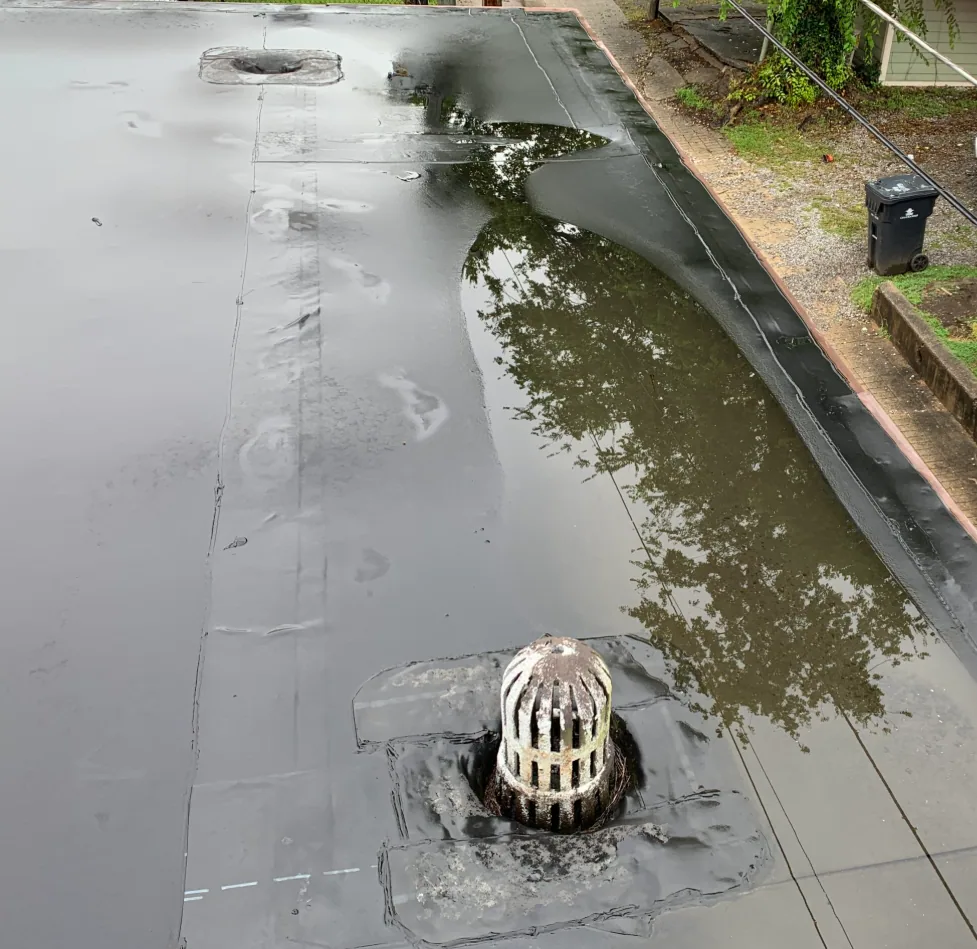
We look at ponding depth and how long water stays after a rain. A membrane that sits under standing water collects dirt and ages faster at the pond edge, and standing water over a seam adds load to a joint that is already working. When water lingers, the cause comes first: a high-set drain bowl, a blocked scupper, deck deflection or compressed insulation. Each needs its own fix, and a ponding water repair that ignores the cause will return.
Flashings and membrane transitions
Most TPO leaks begin at a transition. Pipe boots crack, curb flashings pull away at corners, termination bars lose their seal and coping joints open. A property manager walking the roof may see a clean field and miss a split boot a few feet away.
We inspect every penetration, every wall and every edge, and we compare the interior marks with the roof layout, because a stain in a ceiling rarely sits directly under its entry point. Whether the building sits in the Washington Park Industrial Area or on Johnson Street near US-441, the transition details are checked the same way. Where flashing has been covered by later work, we expose it before judging it.
Attachment, uplift, and code context
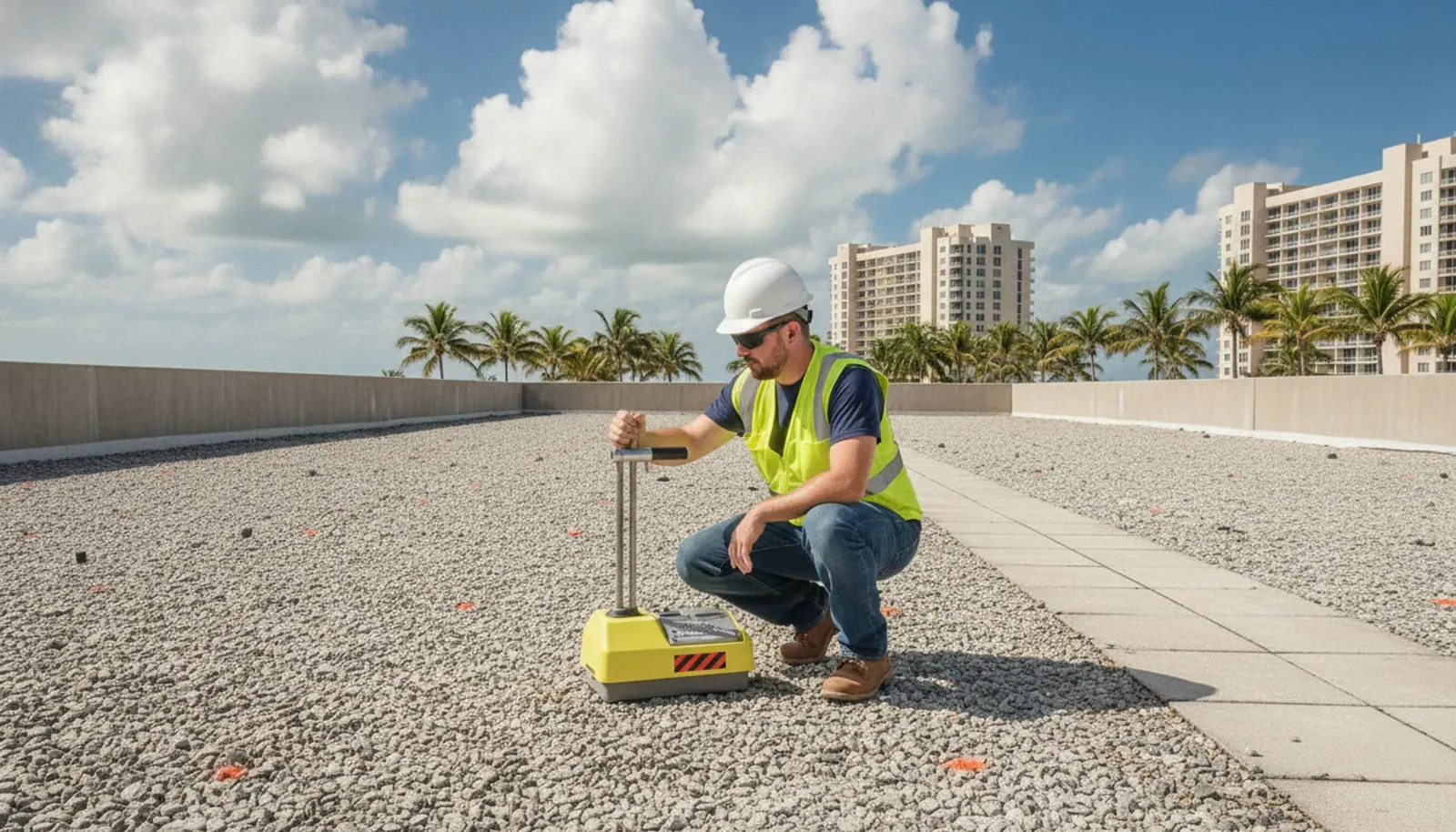
A TPO sheet is held to the building by adhesive, fasteners or ballast, and the method changes what we check. A fully adhered sheet is tapped for hollow spots. A mechanically attached sheet is checked for fastener back-out and flutter along the seam line. A ballasted sheet is checked for stone migration that has bared the membrane.
Florida's 8th Edition (2023) Building Code became effective on December 31, 2023, and Hollywood's Building Division checks reroof work against it. Before a replacement or recover is priced, the permit category and the governing requirements are confirmed with the city, so the scope reflects what the inspector will check.
Repair, recover, or replace the section
The findings sort the roof. Isolated weld failures and flashing defects over dry insulation call for repair. A sound sheet over dry insulation may be a recover candidate when the deck and drainage can carry it. Wet insulation, widespread seam failure or a membrane that has crazed across the field points toward replacement. A moisture survey, either by infrared moisture survey or by core samples, separates these cases without guessing.
Price tracks tear-off depth, insulation thickness, penetration count, site access and permitted work hours. We price roof sections separately so ownership can phase work. A comparison with a PVC roof or an EPDM roof can be built on the same section when chemical exposure, ponding or budget changes the question.
Maintenance records and drying potential
A TPO roof is easiest to manage when its history is written down. We record the sheet thickness where it can be measured, the seam type, the locations of every repair and the date of each inspection. Photographs are taken from the same positions each visit, so a change in a seam, a stain or a patch is visible without relying on memory.
Drying potential matters as much as the surface. A membrane over dry insulation can shed a small amount of water entry without lasting harm, while a membrane over saturated insulation holds moisture against the deck and loses thermal value. After a repair, we recommend a follow-up walk following the next significant rain, because the first wet test shows whether the water entry point has truly closed.
Records also help ownership with decisions that have nothing to do with leaks. A buyer, a lender or an insurer reading a clear file can see what has been repaired and what is monitored.

