Need this roof reviewed?
PVC roof repair, replacement, and evaluation in Hollywood, FL, covering weld probing, exhaust and grease exposure, drainage, and a clear written scope.
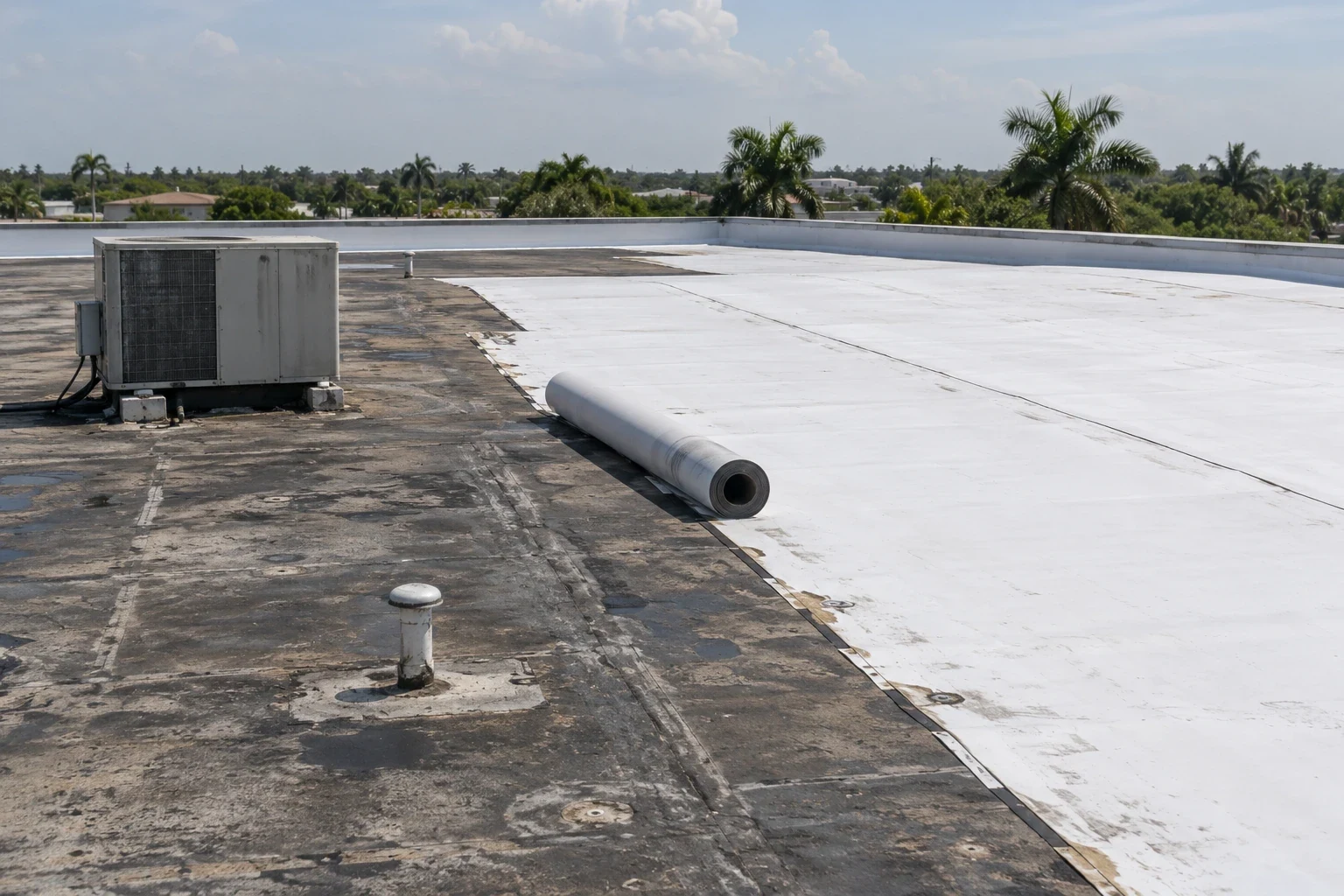
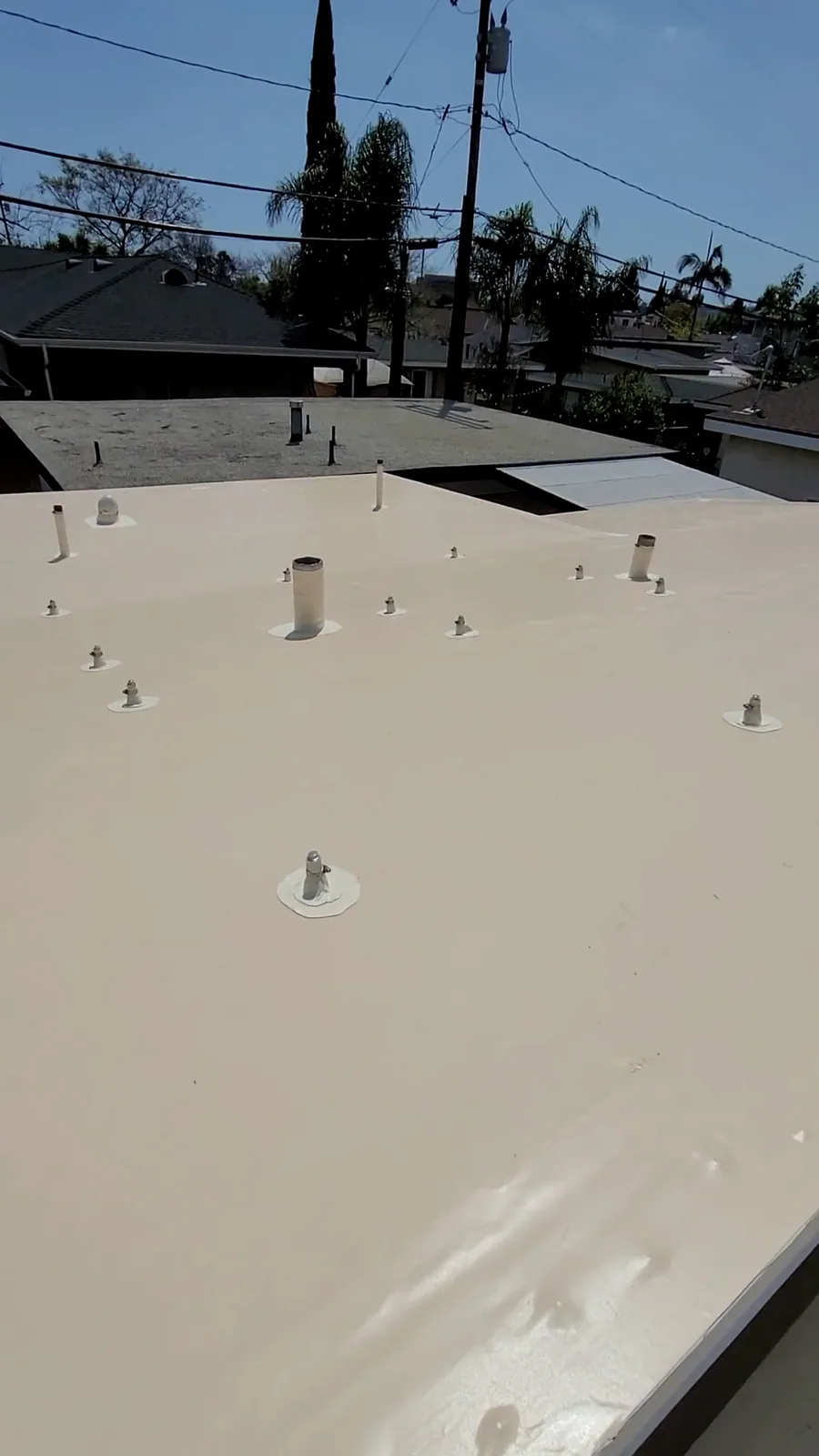
Grease staining around a kitchen exhaust fan tells a roofer something before the membrane does. A PVC sheet is chosen in many cases for resistance to oils and fats, so the roof over a restaurant or a food-service kitchen is a natural fit, yet the same sheet can still fail at a weld, a boot or a drain. Hollywood, FL adds long summer heat and a heavy wet season to those exposures, and a roof near the Atlantic also sits in a city that studies tidal and compound flooding. We start with what is visible: weld lines, staining, ponding and the transitions around equipment. Then we connect each observation to a likely water path and a practical next step, written for a property manager who needs to decide what to repair, monitor or price.
Hot-air welds and seam condition
PVC seams are made by melting two sheets together with hot air, which leaves a bead along the lap. A good weld is continuous and shows even flow at the edge. A poor weld shows gaps, skipped areas, or a ridge where the sheets did not fuse. We run a probe along the lap and look for lifting, then mark the length of every open or soft segment.
Weld problems cluster where seams cross, at corners and around penetrations, because those spots are difficult to weld cleanly in the field. A cross-seam, a wall junction and a pipe boot each deserve their own look. When we find a weak area, the repair is a cleaned, prepared and welded patch, and the record notes its location so the next inspection checks it again.
Welding conditions matter. A sheet that is damp, dirty or too cool will not fuse well, so weld repairs are scheduled for dry, clean surfaces, and the area is tested after it cools.
Grease, exhaust, and rooftop equipment
Kitchen exhaust fans discharge warm air carrying fats and oils, and that residue lands on whatever surface lies downwind. PVC resists many of those substances better than some other membranes, which is why a restaurant roof is a common use, but resistance is not immunity. Residue that is never cleaned can collect dirt, hide a lifted edge and make a repair harder to bond.
Hollywood's Downtown, Beach and Johnson Street business districts are all active commercial settings, and any of them can include food-service buildings. Every exhaust curb gets a check of its flashing, the seal under the fan skirt, grease containment and the placement of walk pads, and we recommend cleaning intervals that fit what we observe.
Plasticizer loss, brittleness, and surface wear
Flexible PVC contains plasticizers that keep the sheet pliable, and over many years some of that material migrates out. A sheet that has lost flexibility cracks at folds, corners and cold-weather stress points. We test pliability by flexing a small, inconspicuous edge and by looking for hairline cracks at fold lines.
The annual mean daily maximum at the NOAA Hollywood station is 83.2°F, a mild-sounding figure that hides summer roof-surface temperatures well above it. Thermal movement happens every day, and an aged sheet takes that movement poorly. Where brittleness appears in one section only, a section replacement may be enough. Where it appears across the roof, the conversation moves toward replacement, and the moisture survey tells us whether the insulation below can stay.
If the roof has a fleece-backed or felt-backed PVC sheet, we also check the attachment pattern, since adhered systems show loose areas as hollow sounds under a tap.
Rainfall, tides, and the drainage plane
Hollywood's climate studies weigh sea-level rise, tidal flooding, storm surge and compound flooding, and the stormwater program looks at rain and tide together. For a roof, the practical lesson is narrower: when downspouts and scuppers discharge into systems that back up, the roof cannot shed water as designed, and ponding follows.
We check drain bowls, sumps, scuppers and overflow openings, and we measure ponding depth and duration after rain. A PVC sheet tolerates some standing water better than many membranes, but a seam under constant water carries stress, and a drain with debris can turn a normal storm into a long soak. A Hollywood Beach building near the Atlantic needs the same review as one inland, with attention to how the outlets discharge.
Flashings, boots, and prefabricated corners
PVC flashings are often prefabricated: boots for pipes, corners for curbs and walls. A prefabricated piece is only as good as the weld that joins it to the field sheet and the termination that holds its top edge. We inspect both. Termination bars that have lost sealant, counterflashing that has pulled away and boots that no longer fit a changed penetration are the usual findings.
When a rooftop unit was moved or a conduit added after installation, the original boot may not fit. We note every change and decide whether a replacement piece, a field-built flashing or a welded patch makes the more reliable repair. The result goes into the roof sketch with a photograph.
Prefabricated corners are checked for fit against the actual curb size. A corner that was cut for a previous curb leaves a gap that sealant can only hide for a short time.
Replace, retrofit, or repair by section
The findings sort the roof into groups. Isolated weld and flashing defects over dry insulation get repairs. Sound sheet over dry insulation can sometimes accept a recover. Embrittled sheet, widespread weld failure or saturated insulation points toward replacement. We price sections separately so ownership can phase the work.
Comparison matters when exposure changes. A KEE membrane adds a chemical-resistant alloy to the PVC family, a TPO sheet may suit a roof with little exhaust, and the Sika Sarnafil system is one PVC specification worth reviewing next to others. The choice follows what the roof sees, not the brand on the roll.
Inspection record and cleaning schedule
A PVC roof stays in good order when it is cleaned and checked on a schedule that matches its exposure. A roof with no exhaust may need a walk twice a year, while a roof under a busy kitchen may need grease checks more often. We write the interval into the report with the reason for it, so facilities staff are not guessing.
Each visit adds photographs from fixed positions, a map of any open weld, the condition of walk pads and a note on drains. The file shows whether a stain is spreading, whether a patch has held and whether the next wet season is likely to test a known weak point. When a roof changes hands, that file answers the questions a buyer or lender asks without a new survey.
Weather adds its own checkpoint. NWS places the stormiest weeks of South Florida's wet season between mid-May and early July, so we aim to finish a spring walk before that window opens.
Related Roofing Topics