
Need this roof reviewed?
KEE and PVC-alloy roof repair, replacement, and evaluation in Hollywood, FL, with weld testing, exposure review, access planning, and clear manager reports.
A roof membrane that is chosen for chemical resistance still has to survive heat, rain and traffic, and a KEE sheet shows its condition in the same places as any other single-ply: at the welds, the flashings and the drains. KEE membranes are PVC-alloy sheets that include a polymer called ketone ethylene ester, which is meant to hold its plasticizer and resist oils and fats longer than ordinary PVC. In Hollywood, FL, summer surface temperatures and a heavy wet season test every membrane, so we begin with observation: weld lines, staining, ponding and the transitions around equipment, followed by a written path from each finding to a practical next step.
KEE composition and what it changes
Ordinary PVC relies on plasticizers added to keep the sheet flexible, and over years those can migrate out, leaving the sheet stiffer and more likely to crack at folds. A KEE sheet incorporates a polymer that is intended to reduce that loss, which can help a membrane stay pliable where heat is persistent or where exhaust discharges onto the roof.
The practical effect is on the repair side. A flexible, well-aged sheet accepts a welded patch, while a stiff one resists it. When we inspect a KEE roof, we test pliability at a small edge, look for hairline cracking at fold lines and compare weld quality across sections. The result tells us whether the sheet is still a good candidate for repair or is nearing the end of its useful life.
Sealants and primers must be compatible with the alloy, so any repair product is checked against the sheet before it goes.
Chemical exposure and rooftop discharge
Exhaust fans, grease hoods and process vents leave residue on the roof, and that residue can collect dirt, soften sealants and hide the edges of a lifted seam. A KEE membrane is often considered where such discharge is regular, such as over a food-service kitchen. The roof still needs cleaning on a schedule, and the area around each discharge point needs a closer look.
For each exhaust curb we look at flashing condition, how the fan skirt seals, whether grease is contained and where walk pads belong, then recommend cleaning intervals that fit what we see. Residue patterns also show wind direction and discharge reach, which helps us decide where to place protective pads. A restaurant roof is the clearest example, since kitchen exhaust is a regular feature of any restaurant, in Downtown Hollywood or anywhere else.
Chemistry is only part of a roof's life. Foot traffic, equipment service visits and wind-blown debris all scuff the surface, and we note worn paths so that walk pads can be placed where technicians actually travel.
Weld quality and seam testing
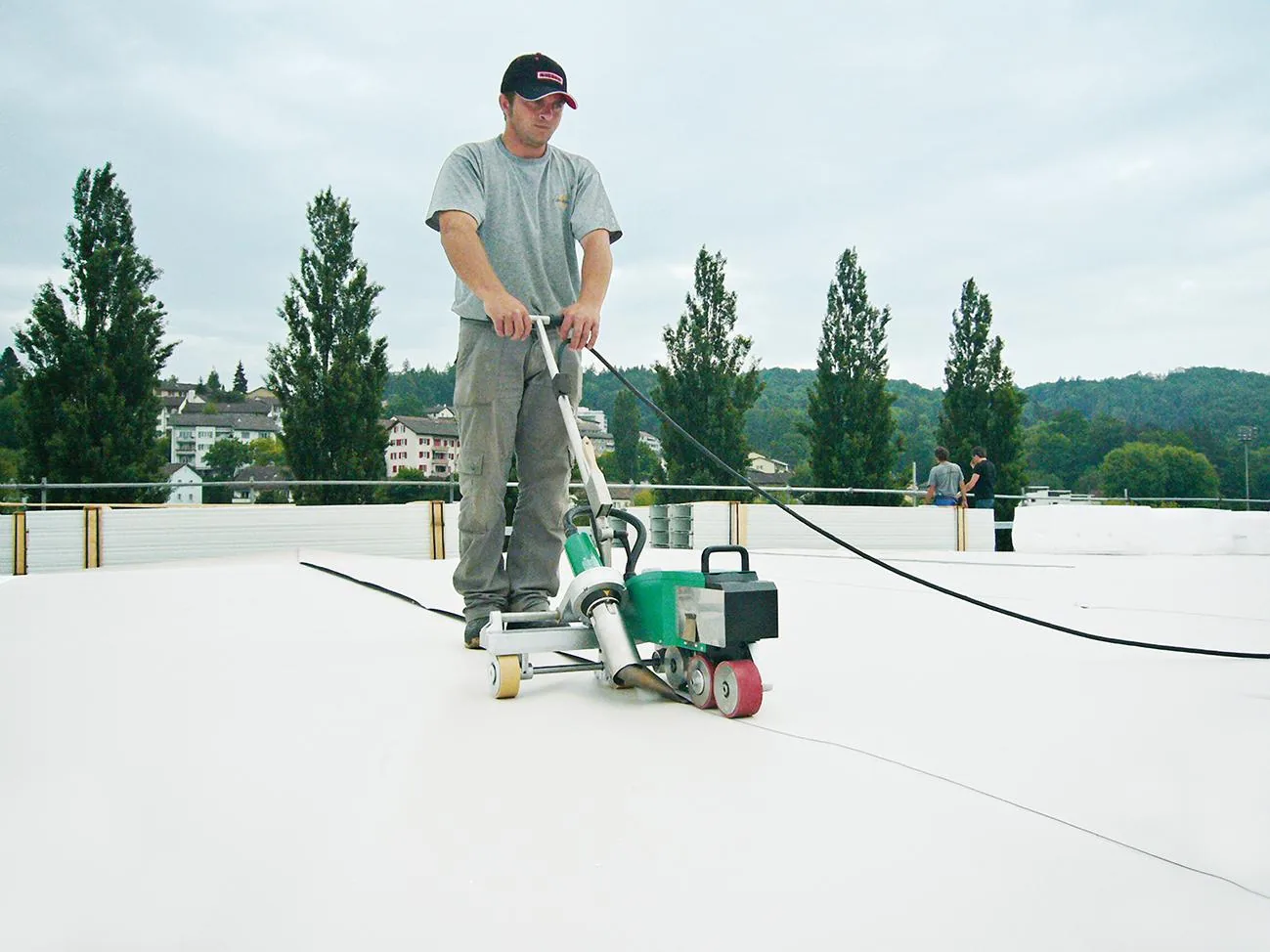
KEE seams are made with hot-air welding, which fuses the sheets along the lap. A sound weld shows an even, continuous bead. We probe along each lap, mark open or soft segments and photograph the results. Cross-seams, corners and penetrations are the spots where welds are hardest to make cleanly, so they get the most attention.
When a weld fails, the repair is cleaned, prepared and re-welded with compatible material. The record notes the location, the date and the product so a later inspection can confirm that the repair holds. Compared with a standard PVC roof, the repair method is similar, but the inspection pays attention to whether the sheet retains its flexibility.
Welds are tested at a consistent pressure and angle, which lets us compare one roof section with another and flag a pattern, not just a single defect. A pattern of soft welds along one wall, for example, may trace to the original installation conditions on that side.
Access in a busy business district
Employee access, deliveries and parking near the Boulevard's event area, between US-1 and 21st Avenue, can all suffer on closure days, so on a roof in or near Downtown Hollywood material deliveries, crane placement and crew parking may be limited on some days.
We ask the manager for the event calendar and plan lifts and deliveries around it. On days when access is restricted, work shifts to interior preparation or to roof areas that can be reached without a delivery. Dry-in plans stay ready for each opened section, because a closure does not pause the weather. Beyond 21st Avenue, the Historic Hollywood Business District continues along Hollywood Boulevard to Young Circle, and we confirm delivery and crane routing with the site contact there as well.
Water, drains, and the wet season
Between mid-May and early July South Florida sees its roughest wet-season weather, with damaging winds, tornadoes, lightning, hail and flooding all most likely, so a KEE roof that drained well in spring should be re-checked once that stretch passes. Drains that work in spring may be tested hard by summer.
We measure ponding depth after rain, trace the route to the outlet and check bowls, sumps, scuppers and overflow openings. Standing water leaves dirt at its edge and loads the seams beneath it, so recurring ponding should be resolved by slope correction or drain work, not by repeated patching. A preventive maintenance visit before the wet season is the most efficient time to clear outlets.
Comparing KEE with other single-ply options
The findings sort the roof. Isolated welds and flashings over dry insulation get repaired. A sound, flexible sheet over dry insulation may accept a recover. Embrittled sheet, widespread weld failure or wet insulation points toward replacement. When a replacement is priced, KEE can be compared with PVC and with a TPO roof on the same section, with attention to exposure, ponding and budget.
We list the sheet, the insulation, the attachment, the flashing details and the expected inspection interval for each option, and we state what is uncertain. Ownership can then choose with the facts side by side.
Records for a changing building
A KEE roof file lists the sheet type where it can be identified, the date and location of every repair, the condition of each exhaust curb and the findings from each walk. Photographs come from fixed positions so changes are visible. When a building changes tenants or equipment, the file shows what was added to the roof and whether the added penetration was flashed correctly.
That record helps ownership plan. A section with a clean history can wait, while a section with repeated repairs moves up the list. A buyer or lender reading the file sees condition and maintenance habit, not a guess.
Related Roofing Topics