Need this roof reviewed?
Cold storage and freezer building roof inspection, repair, and replacement in Hollywood, FL, with vapor and moisture analysis, penetration review, and records.
A freezer roof lives between two climates. Below the deck the air is held well under freezing, and above the membrane Hollywood, FL sits at an annual mean temperature of 76.1°F with a wet season that peaks in June and September. Water vapor moves from warm, humid air toward cold, and if it finds a path into the insulation, it condenses and freezes. The result is ice where a roof assembly should be dry, and an insulation layer that no longer insulates. So a cold storage roof is read differently: we look at the vapor path as closely as the water path, and we start with the penetrations, joints and details that can connect the two climates. Then we write a record of what is dry, what is wet and what must change.
Mean daily highs at the NOAA Hollywood station average 83.2°F across the year, and August averages 89.9°F, so the temperature difference across the roof assembly on a summer afternoon is large. That gradient is why small defects matter more here than on a dry-storage roof.
Vapor drive across a cold assembly
Vapor pressure pushes moisture from the warm, humid side toward the cold side. In a cold storage building, that means from the roof exterior toward the freezer. A vapor retarder in the assembly slows that movement, and the membrane above keeps liquid water out. If either layer is breached, moisture reaches cold insulation and collects.
We look for the signs of that process at the roof: blistering, softened insulation, staining at seams and unexpected wet readings in a roof that has had no leak. Inside, we ask about frost on ceilings, ice around fixtures and condensation on the underside of the deck. Those clues point to where the assembly has been breached and help separate a roof leak from a vapor problem.
Frost patterns tell their own story. A line of frost along a joint, a patch of ice above a light fixture or a ring of condensation around a pipe each suggests a different breach, and we photograph them with their positions marked on the interior plan.
Wet insulation and ice formation
Wet insulation in a freezer roof turns to ice, which expands, loses thermal value and can damage the deck and membrane. A small breach can feed a growing ice mass over months. By the time frost or drips show inside the cold space, the wet area may be large.
Meters, infrared scanning and patched core samples together show where moisture sits, and the wet areas are drawn on the sketch. The wet-area map shows how far moisture has traveled. Small wet zones can be cut out and replaced. Widespread wetness means the assembly needs replacement of that section, and the report states the reasons with photographs.
Interior survey notes complete the picture: frost maps, ceiling temperature readings and the locations of any ice formation are recorded next to the roof findings. A cold storage facility in the Johnson Street business district, which runs along Johnson Street between 56th Avenue and US-441, gets the same interior-and-roof pairing.
Penetrations and thermal bridges
Every pipe, conduit and support that passes through the roof is a path for heat and vapor. In a cold building, an uninsulated or poorly sealed penetration can show frost, drip and let humid air in. Refrigeration lines, electrical conduits, sprinkler pipes and structural supports all deserve attention.
We inspect each penetration for flashing condition, sealant, insulation around the pipe and signs of condensation. Where a penetration was added after the original roof, we check how the vapor retarder was tied to it. A penetration flashing that looks sound outside may still allow air to leak inside, so interior observations are part of the review.
Refrigeration piping that enters the building through the roof is particularly sensitive, since cold lines sweat in humid weather and drip onto whatever lies below. Insulation and sleeves at the penetration are checked for gaps.
Refrigeration equipment and rooftop loads
Condensers, fans and piping often sit on the roof of a cold storage building. They add weight, vibration and penetrations. Water from defrost cycles or condensate lines can run across the membrane, and refrigerant lines need supports that do not damage the sheet.
We inspect curb clusters, supports, drain lines and the membrane beneath, and we note any place where condensate runs onto the roof. Heat rejection from condensers raises local surface temperature, which stresses the membrane near them. We recommend walk pads, supports and, where needed, a repair to the sheet beneath. Each cluster is logged so the roof record shows how equipment has changed over time.
Drainage in a humid, rainy climate
A roof over a freezer cannot afford standing water: June rain of 8.84 inches and September's 8.67 inches in the NOAA normals test the drains twice a year, and NWS places the stormiest weeks in mid-May through early July.
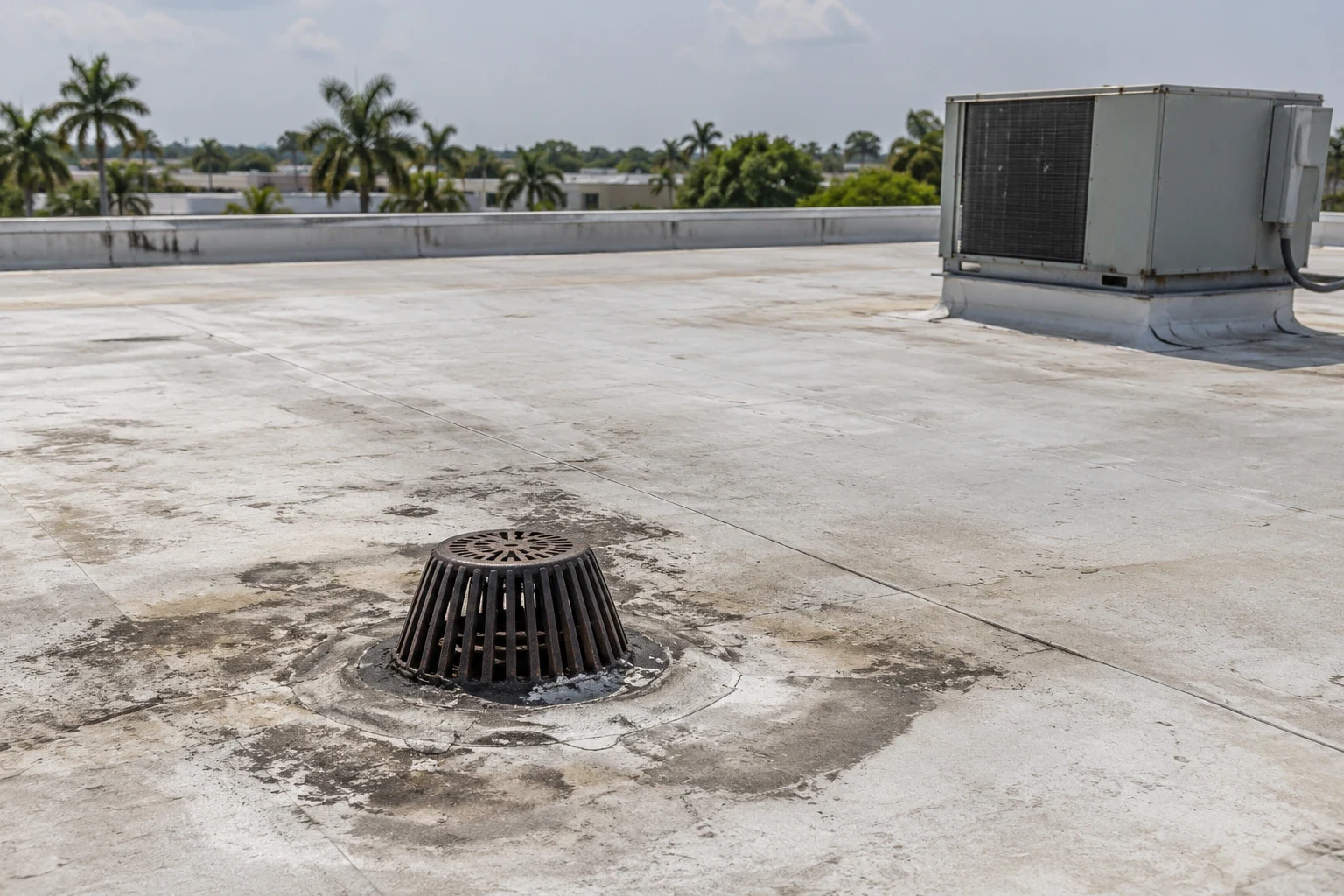
We measure ponding depth after rain, clean and test drains, scuppers and overflow openings and trace the route to the outlet. Because the City models rainfall and tides together, we assume the receiving system can run slow and check that overflow routes exist and are clear. Blocked drains put water exactly where a cold roof is least tolerant. A roof drain and scupper review is part of every visit.
The drainage and vapor checks are the same whether the building stands in the Washington Park Industrial Area or elsewhere in the city, and delivery routes are confirmed with the manager first.
Operating constraints and work windows
A cold building runs continuously. Dock doors open to trucks, temperatures are held and product moves on a schedule. Roofing work cannot interrupt temperature control or leave openings in the vapor barrier. Hot work near insulated panels needs fire controls, and fumes must stay away from intakes.
We plan the work in small sections. Each opened area is closed and sealed before the crew leaves, with the vapor retarder and insulation restored in the same shift. Interior protection covers product and equipment below the work zone. The plan is written with facility management, with attention to temperature alarms and dock schedules, and it is updated if conditions change.
Repair, replace, and the record
Findings sort the roof. Isolated membrane or flashing defects over dry insulation get repaired. Wet insulation, ice formation or a breached vapor retarder calls for section replacement with a restored assembly. Cost follows area, tear-off depth, insulation, vapor control, penetration count and the hours the building allows. A warehouse roof and a distribution center roof are related, but a cold roof adds vapor and thermal-bridge questions that change the scope.
The closeout record lists sections repaired, the vapor and insulation details restored, moisture readings, photographs and a recommended follow-up after the first wet stretch.

