Need this roof reviewed?
Skylight, curb and pipe flashing repair for commercial roofs in Hollywood, FL, with water-entry tracing, glazing seal checks and membrane tie-ins.
Every opening in a roof is a break in the water barrier, and the flashing around it is the repair that makes the break safe. Skylights, roof hatches, pipe stacks, conduit supports and vent collars each carry a small ring of sealant or formed metal that moves with the sun and ages faster than the field of the roof. In Hollywood, where August afternoons sit near 90 degrees and the wettest months deliver close to nine inches of rain, those rings get heat all summer and rain on top of it.
When an interior stain appears below a skylight or a pipe chase, the first suspect is the flashing. We confirm it by tracing the water path before replacing anything, because a leak near a skylight is not always the skylight's fault.
Some openings fail from movement more than age. A pipe that is fastened to the building and also passes through a roof will flex the boot every time the building shifts or the pipe heats up. We check for rigid connections that should be flexible, supports that bear on the membrane and conduit that bridges two roof levels, because the cure there is a support change before it is a flashing change.
Tracing the Water Entry Point
Water travels along the deck, the insulation and the underside of a curb before it drips. A stain at a skylight well may begin at a seam several feet upslope, at a drain or at the glazing itself. We map the stain against the roof layout, then climb to the opening and work outward in a ring: the curb flashing, the counterflashing, the glazing seal, the frame joints and the membrane beyond.
For condensation, the pattern differs. Moisture that forms on cool glass or a metal frame and runs down leaves a clean, repeated track on cool mornings. A leak follows rain, and it often shows first at the lowest corner of the frame. We ask when the stain appeared and compare it to the weather, then test with a controlled water run, starting low on the curb and working up so the entry point shows itself.
Skylights and Hatches
A skylight has three places to leak: the glazing seal, the frame and the curb flashing. Glazing gaskets and sealants harden in heat and crack. Frames can open at the corners as the unit moves. The curb flashing, where the membrane turns up and is capped by metal, can pull away or shrink.
We inspect each element, look for crazing in plastic glazing and note whether the dome is original or a replacement. Where a skylight is worn out, replacing the unit and reflashing the curb together is often less costly than repeated sealing. Roof hatches get the same check: gaskets, hinges, latch and the flashing at the curb. A hatch left open in a storm, or one whose latch no longer holds, lets rain in even when every seal is sound, so we test the closing action as well. A leak near a hatch is traced the same way as any other, and commercial roof leak repair starts with the hatch seals and the curb before moving upslope.
Pipe Stacks, Conduit and Vent Collars
Round penetrations are flashed with a boot, a collar or a liquid-applied detail. Rubber boots crack in sunlight and split at the top edge. Metal collars loosen. Sealant pockets, a common detail around grouped conduit, dry out and shrink away from the pipe.
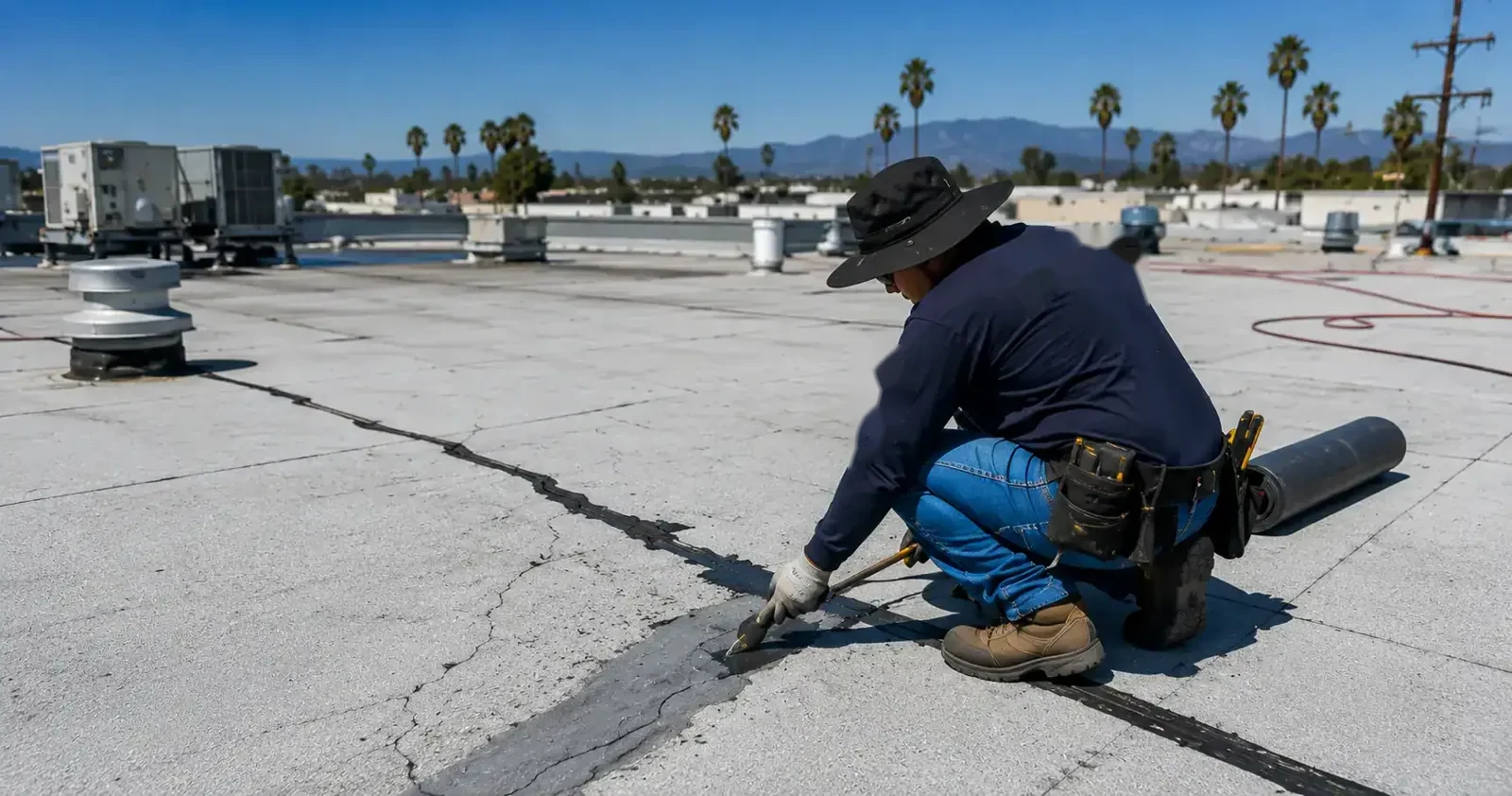
On a TPO roof, we replace a failed boot with a prefabricated flashing welded to the membrane. On modified bitumen, we use compatible flashing and adhesive. Where several penetrations cluster, a pitch pocket or a liquid-applied flashing resin, reinforced with fabric, may suit better than separate boots. These details cure in place and conform to irregular shapes, but they depend on a clean, primed surface and on weather that lets them set. In every case, the repair is matched to the membrane, and the old sealant is removed instead of layered over.
Conduit and cable penetrations deserve special mention. Wires added over the years often pass through a single patched hole, sealed with whatever was at hand. We open the pocket, remove old fill, consolidate the cables where practical and reseal with a material rated for outdoor use and for the temperature range the roof sees.
Flashing Height and Termination
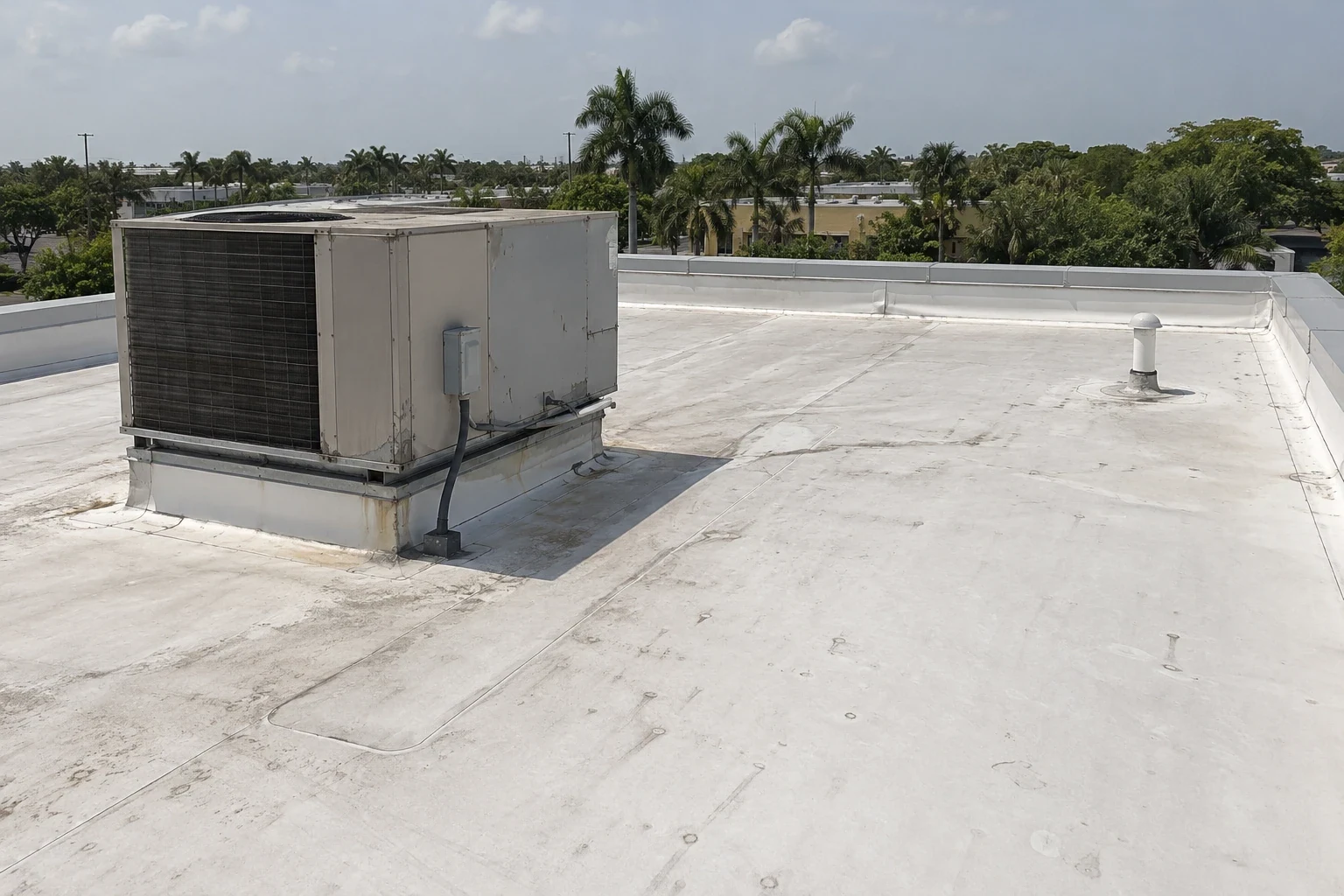
Flashing needs enough rise above the roof surface to stay clear of standing water. A curb whose flashing sits only an inch or two above a pond is overtopped by the first heavy rain, and the water then runs behind the flashing instead of over it. The fix may be a taller curb flashing, a cricket upslope that sends water around the opening or a drain placed nearer to it. We measure flashing height at the worst-drained penetrations and report any that fall short, since adding rise is a repair, not a patch.
The termination, where the flashing ends at the top, is equally important, and it is the part most often overlooked in a quick patch. It is secured with a bar, a clamp or a counterflashing and sealed above. When the sealant cracks, water runs behind. We check each termination line and reset, reseal or replace as needed.
Heat makes the schedule. Sealants and liquid flashings cure best in a steady, dry window, and a summer afternoon with a storm cell approaching is the wrong time to open a penetration. We open only what can be closed the same day, protect each opening with a temporary cap if weather threatens and return to finish the permanent detail.
Historic Districts and Preserved Details
Harrison and Tyler, two designated historic districts, hold a mix of residential, commercial and mixed-use properties, with many buildings in 1920s-era styles, while the Historic Hollywood Business District follows the original 1921 plan along Hollywood Boulevard. A building in either may have openings of many kinds, and some may have been added after the original construction. We do not assume what is there. We inspect the roof, identify each opening and flag any that sit within a historic designation, since visible changes may need review before work.
Owners in the Harrison and Tyler historic districts or the Historic Hollywood Business District get the same documented scope as any other roof: photographs, a sketch, measurements and a sequence.
Records and Related Work
The closeout record lists each opening, the repair made, the products used and photographs before and after. It supports a later equipment curb job or a scheduled maintenance visit, when each flashing is checked again.

