Need this roof reviewed?
Commercial roof inspection, repair and replacement in Downtown Hollywood, FL, scheduled around event closures, deliveries and active tenant buildouts.
A parapet drain that clears at nine in the morning can overflow by three in the afternoon in August, because the heat path and the downpour arrive on the same day. Downtown Hollywood is a district of shops, restaurants and services with a business association and a property owners group behind it, and commercial roofs there answer to both the weather and the street calendar. Commercial Roofers Hollywood inspects, repairs, replaces, recovers and coats low-slope and metal roofs in the district. Each visit begins with the water entry points and the drainage plane, and the roof walk is timed around deliveries and events so that the work does not add to a crowded day.
Event Closures and Delivery Routes
Along Hollywood Boulevard between US-1 and 21st Avenue sits the Downtown Hollywood event area, where, per the city's business resource guide, closures change how staff, delivery drivers and customers get to a building. For a roofing job, that sentence is a scheduling constraint. A material delivery, a lift or a dumpster swap needs a curb, a lane and a window, and an event closure can remove all three on the same day.
We ask the property manager for the event calendar and the loading arrangements before we set a start date. Heavy picks and tear-off are planned for days without closures, and small repairs are fitted to quieter hours. If a street closure is unavoidable, the city process sets its lead time, and the schedule carries that lead time instead of assuming it. The work order names the access point, the staging area and the person who can approve a vehicle move.
Roof access is its own constraint. A ladder or hatch that opens into a tenant space needs notice and an escort, and a shared stair may be closed during business hours. We confirm the route to the roof, the weight a lift can place on the sidewalk and the distance from the staging point to the work, because each of these changes how many people the job needs and how long a section can stay open.
Heat and Downpours Over a Mixed Street
The August daily maximum at Hollywood's NOAA station is 89.9 degrees, and the heaviest monthly rain comes in June at 8.84 inches, then September at 8.67. The wet season's roughest weather in South Florida arrives between mid-May and early July, based on National Weather Service guidance, which is the window a downtown roof has to be ready for. Surface temperature on a dark membrane runs well above the air temperature, so thermal movement works on seams and edge conditions every day, and the rain then tests every transition.
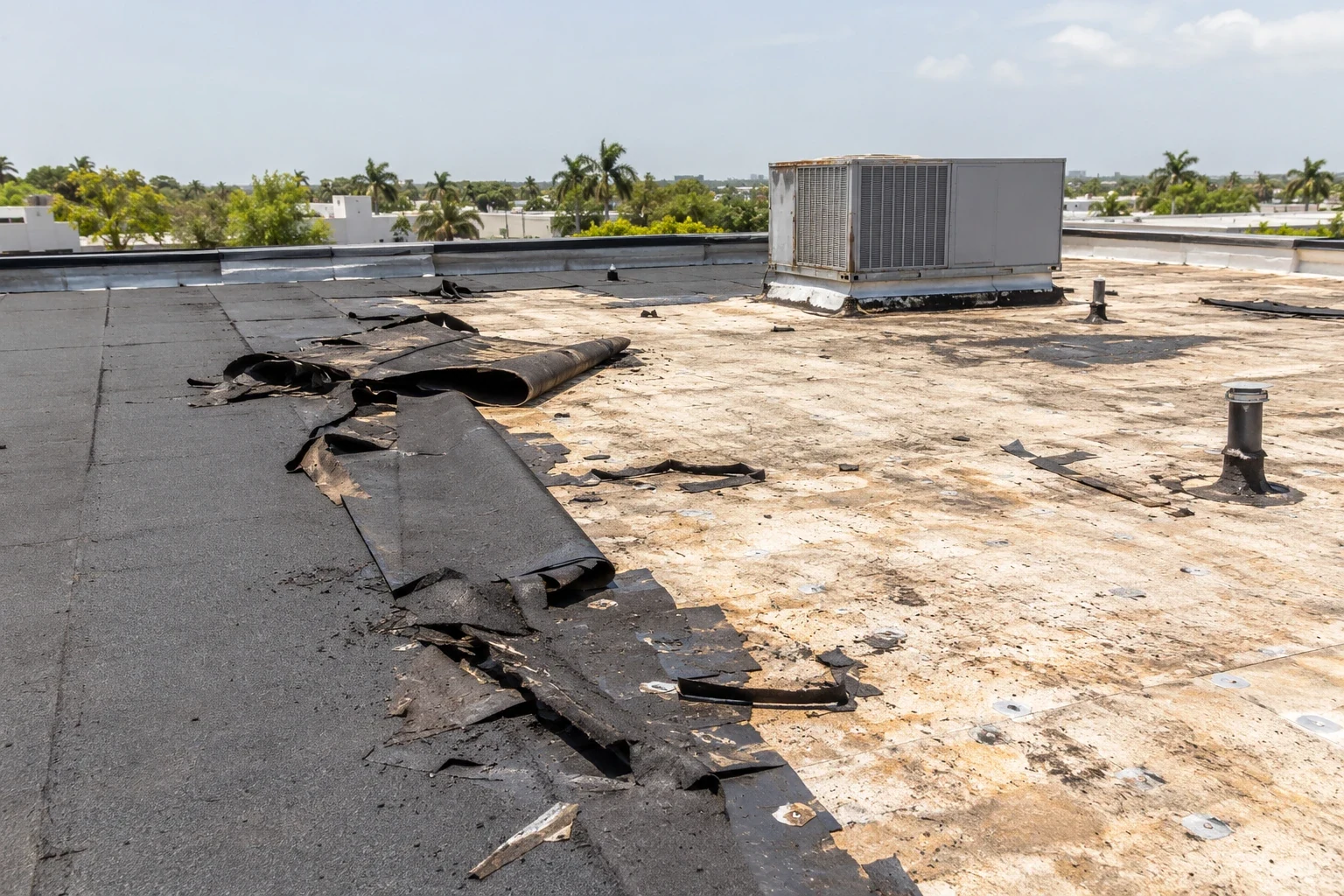
Downtown buildings with parapets and interior drains hold water longer when outlets slow. We measure ponding depth after rain, check whether scuppers discharge freely and look at the membrane transitions at walls and curbs. A moisture route that begins at a failed termination can wet insulation for a long distance before it appears on a ceiling, so the interior stain is only the first clue.
Tenant Buildouts and Roof Penetrations
Downtown's property owners association concentrates on leasing strategy, tenant mix, buildout quality and permitting coordination, and each of those touches the roof when a new tenant adds equipment. Every new restaurant exhaust, rooftop unit or antenna that comes with a buildout adds a penetration to a roof, and each penetration is a place where the membrane has been cut. When a trade other than a roofer sets the curb or boot, the flashing is often the weakest point on the roof within a few seasons.
On a first walk we count the penetrations against any record the owner has, flag those that appear to have been added without proper flashing and photograph each with a scale reference. We recommend that new penetrations be set or flashed by a roofer and logged with a date. For a restaurant roof, we also check the surface around the exhaust for grease residue and softened membrane, since the repair material must tolerate it.
Repair, Recover or Replace
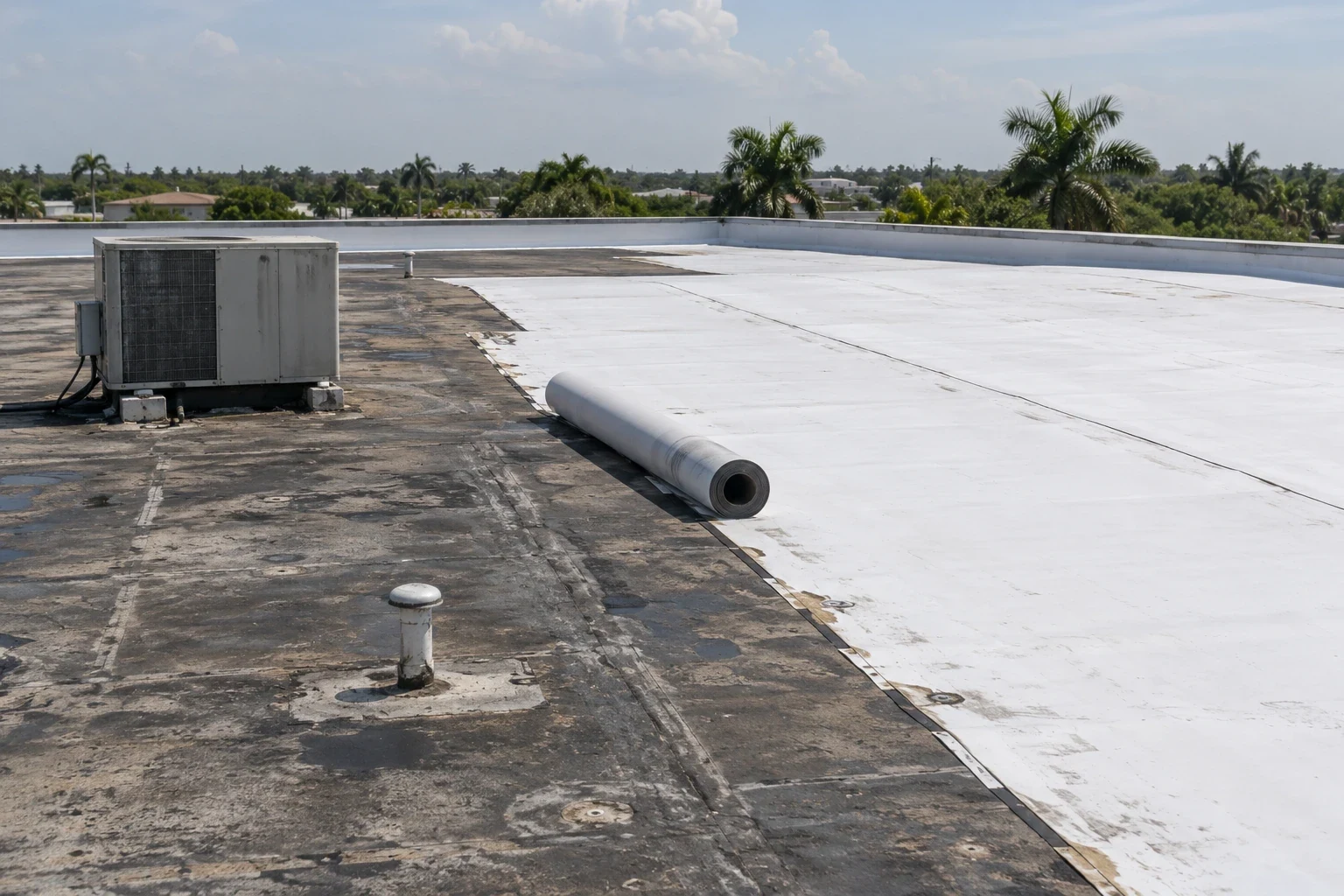
The decision rests on drying potential and on how many assembly layers are in place. A local repair is appropriate when the surrounding membrane is sound and the insulation is dry. A recover is possible where existing layers are few and dry. A replacement removes wet or failed layers and is the answer when moisture is widespread. We test with a moisture meter, an infrared scan where conditions allow and test openings, then price each option on the same assumptions.
Permits are part of the decision. Reroofing is reviewed by the city's Building Division, which enforces the Florida Building Code, 8th Edition (effective December 31, 2023), and reroof permit categories appear in the city's online permitting information. We confirm the path for the specific scope before we order material.
Cost moves with the same few items on every building: the extent of wet insulation, the number of layers, penetrations and edge length, deck repairs, and the amount of phasing needed to keep tenants in place. We list them as separate lines, so ownership can see which are tied to the roof and which to the occupancy.
Edges, Drains and Scuppers
On a building with parapet walls, the edge condition and the drainage detail decide most leaks. A scupper set a little high holds a shallow pond, a drain with a cracked flange leaks at the bowl, and a counterflashing that has lost its sealant lets water behind the membrane turn. We trace each outlet to its discharge, flush it, and look at the clamping ring and the membrane transition into the bowl. Coping and edge metal are checked for open joints and lifted fasteners.
Where a building's walls and roof have been repaired many times, we map previous patches on the plan so the record shows where the roof has already needed help. A cluster of old patches around one drain says more about the drainage plane than any single repair, and it moves the discussion from patching to correcting the cause. The scope separates a drain detail from broader membrane or slope work, and each is priced on its own.
Records for Ownership and Neighbors
The closeout file holds the roof plan, photographs by zone, test results, the materials and details used and any open items. The central business district is part of Hollywood's original 1921 layout, with a planned mix of residential, business and recreational uses, and the age of a district does not identify the roof on any one building, so a record of each roof assembly is more useful than an assumption. A downtown owner with a second building in the Historic Hollywood Business District or over in the Beach district can have both roofs walked on one visit, saving a second mobilization. Emergency roof repair is available at any hour.
Related Roofing Topics