
Need this roof reviewed?
Insulation replacement, tapered slope systems and cover board for commercial roofs in Hollywood, FL, based on moisture findings and drainage readings.
Under the membrane, insulation does three jobs at once: it slows the heat path into the building, it gives the membrane a flat bed to rest on and, in a tapered system, it builds the slope that moves water to the drains. A mean annual temperature near 76 degrees and August highs close to 90 make heat load a year-round factor on Hollywood roofs, and heavy seasonal rain tests the drainage the insulation shapes. When insulation gets wet or crushed, all three jobs suffer.
Compression is the quieter failure, and it builds up slowly. Rooftop traffic, equipment feet and ladder legs press into soft boards over the years, leaving dents that hold water and stress the membrane above. A dented board still insulates, but it no longer supports the sheet, so we mark compression zones on the sketch alongside the wet ones.
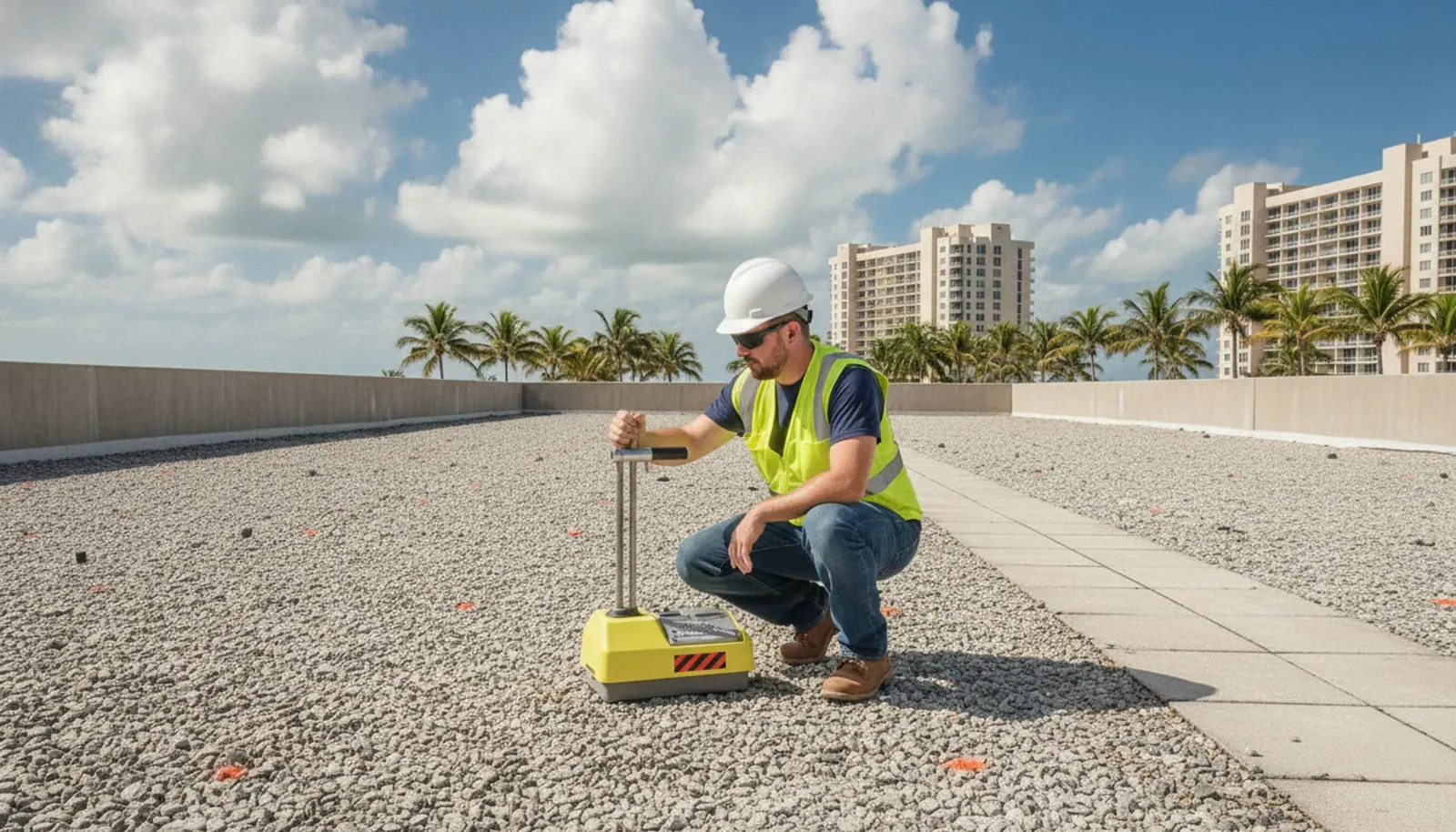
We evaluate the layer directly. Moisture readings, core samples and a drainage survey tell us whether to replace a few boards, add slope or leave the layer alone and protect it with a cover board.
Moisture and Drying Potential
Insulation that holds water loses thermal value, adds weight and can swell or delaminate at its facers. The question for a repair is how much is wet and whether it can dry. A small wet patch near a flashing, sealed from the source, may dry slowly under a vapor-permeable cover. A saturated field under a closed membrane has little drying potential and will keep feeding blisters and leaks.
Timing matters for scans, since roofs show the clearest thermal contrast after a sunny day cools into evening. Moisture mapping uses probes, meters and, across larger areas, an infrared moisture survey taken at the right time of day, followed by a core patched the same day. Wet boards come out, and the removed material is photographed and measured so the quantity is on record. The cut is squared and sealed, and on a PVC roofing or other single-ply system the membrane above is re-welded or re-adhered to the patch, and replacement boards go in fastened or adhered to the pattern the system requires, so the repair does not become a new weak point.
Insulation Types and Their Behavior
Polyisocyanurate is common on low-slope commercial roofs because it offers good thermal value in a thin board. Extruded and expanded polystyrene resist water differently and suit some assemblies. Mineral wool and perlite boards add fire resistance or compatibility with certain systems. Each responds to heat, moisture and compression in its own way.
We identify the board where we can by facers, thickness and cores. Thickness matters for more than heat: a thin patch beside a thick board leaves a step at the seam, and that step can pond water or cut the membrane. Mixed layers are common, with older boards below and newer ones above, and the interface between them can trap water. We note the layers, their condition and the fastening pattern, because adding a new membrane over a poorly fastened board risks wind uplift at the edges. The 2023 Florida Building Code addresses structural and energy matters that touch insulation, and the building division reviews permitted reroofing, so we confirm which apply before specifying.
Tapered Systems and Slope
Tapered insulation is cut in wedges that add slope across the roof. It directs water toward drains and eliminates the low spots where ponds form. It works best when planned with the drain layout, and a good design places crickets behind curbs and walls so water does not dam.
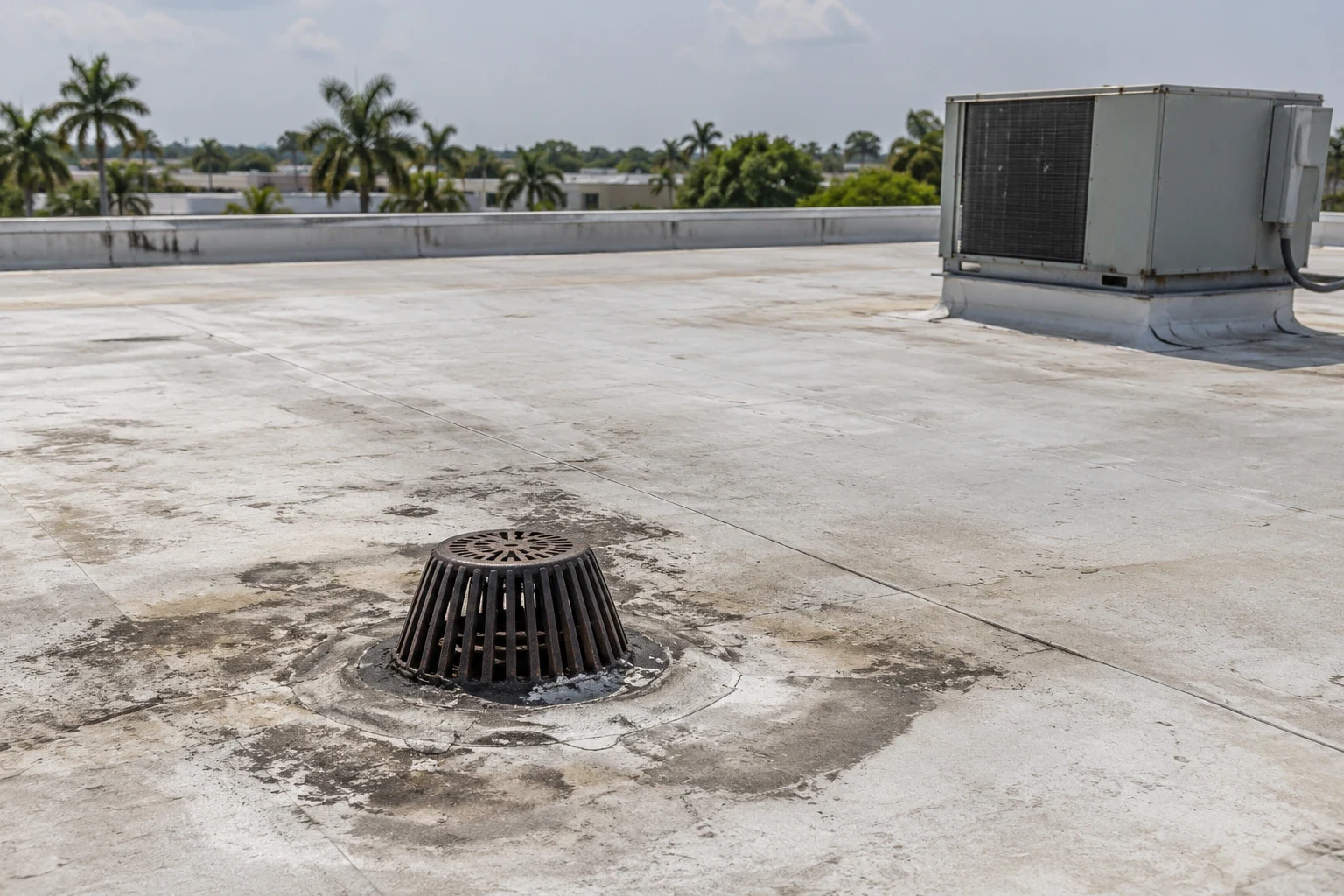
We survey ponding depth and flow path before proposing taper. If water collects in three spots, the fix may be a few crickets and a drain adjustment, not a full tapered system. If the whole roof is flat and ponds widely, a full taper may be worth its cost. The design also has to respect the drains. Taper that ends at a drain sump leaves a smooth path, while taper that stops short leaves a flat strip where water lingers. The proposal lists the area to be sloped, the thickness at the thinnest and thickest points and the effect on flashing heights, because added thickness raises the roof surface and can leave wall and curb flashing too low. Our drain and scupper work is coordinated with the layout.
Cover Board Choices
A cover board is a thin, hard layer between insulation and membrane. It resists foot traffic and impact, spreads loads from equipment and offers a smoother, more stable base for adhesives. It also protects softer insulation from damage during roof work. Gypsum-based, fiber-reinforced, wood-fiber and high-density polyiso boards are all used, each with different moisture and strength behavior.
The choice depends on the membrane, the attachment method, the exposure and the traffic. A cover board costs more upfront, and it can reduce the chance of bruising and blistering later, especially under adhered membranes that rely on a smooth, strong base. Where a roof sees frequent rooftop access, a cover board is often worth its line item. We state the reason for including or omitting it in each proposal. Fastening or adhesive for the cover board is specified together with the membrane attachment, since the two layers work as one under wind load.
Fire and moisture ratings can also steer the choice. Some boards resist moisture better during construction exposure, and some carry fire-resistance classifications that suit certain assemblies. We check that the combination of insulation, cover board and membrane is one the system manufacturer allows.
Industrial and Commercial Roofs
Insulation needs differ by use. A roof over a conditioned office carries a different heat load than one over open storage. Hollywood has a named redevelopment program for the Washington Park Industrial Area, and industrial roofs in a district like that may support heavy rooftop equipment, so compression strength matters. Mixed-use blocks in Downtown Hollywood have tenants whose comfort and energy costs depend on the layer, and a replacement is an opportunity to correct thermal performance along with the membrane. We do not promise an energy result, but we do record the thickness and type installed, so the owner has the data when asking a utility or an engineer what the roof contributes.
We price insulation work with its cost drivers: board type and thickness, area replaced, fasteners or adhesive, taper, cover board, deck repair and disposal. A full replacement is the usual moment to rebuild the layer, and a targeted repair addresses only what moisture has damaged.