Need this roof reviewed?
Roof capital planning for Hollywood, FL owners: replacement timing, cost drivers and wet-season scheduling set against the observed condition of each roof.
A roof that is repaired three times in two summers is spending capital a little at a time without ever buying anything lasting. The invoices look small, the leaks keep returning, and the replacement that eventually arrives is both late and rushed. Capital planning is the discipline of seeing that pattern early, then choosing a date, a scope and a budget on purpose. In Hollywood, FL, the plan has to respect a climate that loads roofs with heat and rain for much of the year, so the work is scheduled around the weather as carefully as around the money. We build the plan from observed condition and let the numbers follow.
The replacement horizon and the repair boundary
Every roof has two lines worth drawing. The repair boundary marks where patching stops being sensible: the extent of wet insulation, the number of repeat leaks, the share of seams that fail a probe. The replacement horizon is the estimated window in which the assembly will reach that boundary. Both come from evidence collected in the field and kept in the roof asset register, and both are written in ranges.
A roof still well inside its boundary can be maintained and watched. A roof near the boundary needs a decision on timing. A roof beyond it needs funding and scheduling. We place each building on that scale, show the reasoning and mark what new evidence would move it, such as a failed moisture re-check or a second leak at a repaired seam.
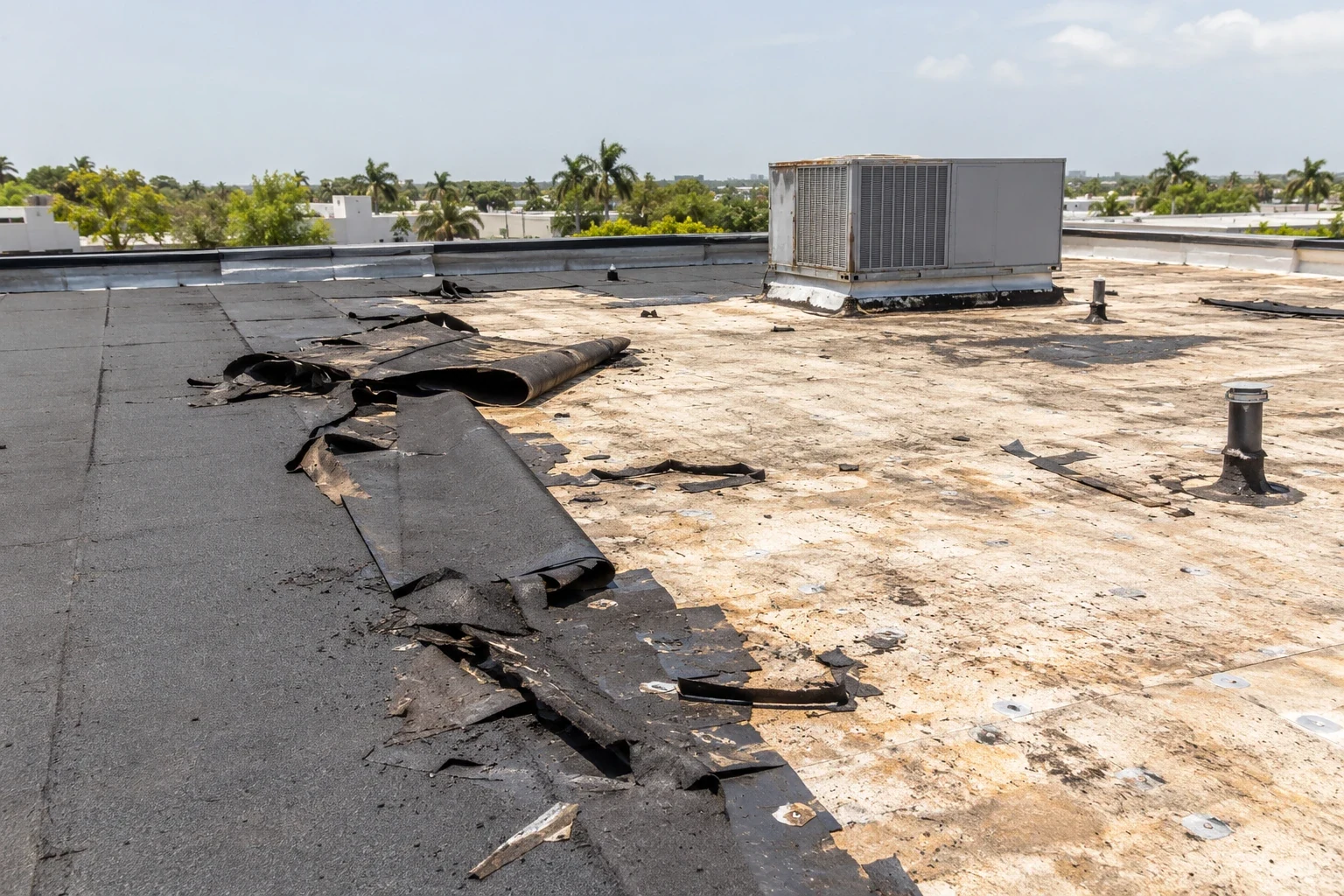
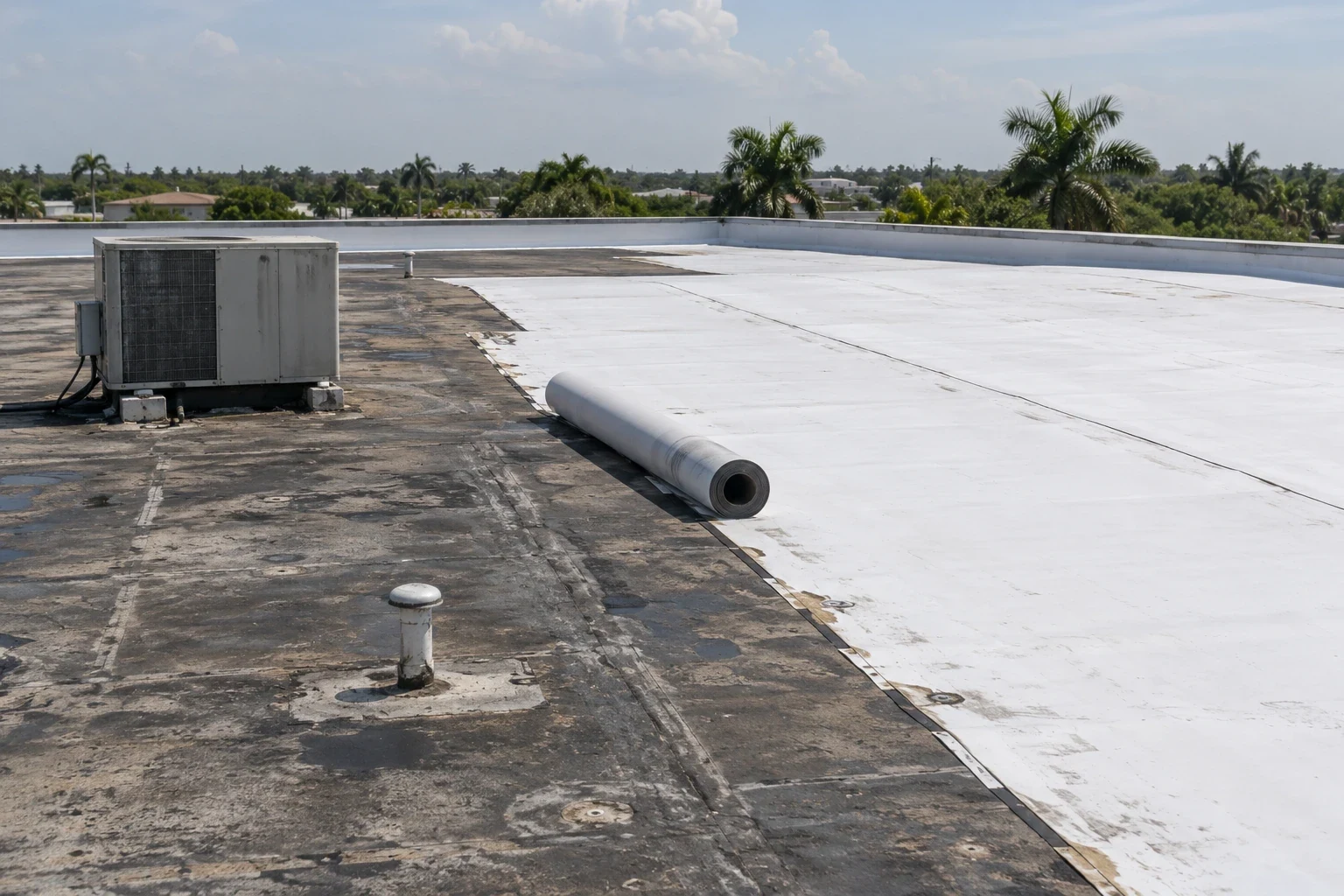
Wear that is uneven calls for a section-by-section view. A roof can have one area near its boundary and another with years left, and the plan can treat them separately, replacing the worn section now and scheduling the rest later. The line between sections is flashed and documented so the later work ties in cleanly.
Cost drivers in a South Florida reroof
Cost follows the building more than the membrane brand. Tear-off depth, the thickness and type of insulation, tapered insulation for drainage, the number of penetrations, edge metal and coping, access for hoisting and the need to protect occupied space all move the number. Attachment is also a driver, since the Florida Building Code, Eighth Edition (2023), governs reroofing in Hollywood, and the Building Division reviews plans and inspects the work.
Each driver gets its own line in the plan, and where the roof has to be opened before a quantity can be known, the line carries an allowance instead of a firm number. That way the budget is clear about what is firm and what is an allowance. A commercial roof replacement scope and a recover can be set side by side on the same sheet, with the conditions that make each one possible.
Hidden conditions are the usual reason a final figure moves. Wet insulation, a soft deck or an old layer of material that was never removed show up only when the roof is opened. Test openings before pricing reduce the surprise, and an allowance with a stated unit rate settles what is left.
Repair, coating, recover and replacement as budget options
Capital plans often treat replacement as the only choice, but the options form a ladder. Targeted repair holds a sound roof. A restoration coating can extend a bonded, dry membrane when moisture tests allow it. A recover adds a new membrane over a suitable existing roof. Replacement removes the old assembly and starts again.
Each rung has requirements. Coatings need dry insulation and good adhesion. Recovers need a roof that can carry another layer and a base that will hold fasteners or adhesive. Replacement is open to any condition. We test the conditions first, then show which rungs are available and what each costs over time, because a cheaper option that fails early costs more than the one that lasts.
A ladder is also a sequence. A coating applied now, followed by a replacement in a later cycle, can spread cost across years if the substrate qualifies. The plan shows both timelines in the same table, so ownership sees the total over the period and not just the first price.
Scheduling around the wet season
Hollywood's June and September rainfall normals are each about 8.8 inches, and the National Weather Service puts the worst storm weather of the wet season between mid-May and early July, so drainage and edge work move to the top of a spending queue. A reroof that opens the building during those weeks carries weather risk, so the plan places heavy work in the drier months where the budget allows and reserves the stormy phase for maintenance and emergency repair.
Material lead times matter too. Ordering ahead of the window keeps the crew from waiting on delivery, and a phased plan keeps open roof area small. The calendar goes into the plan along with the fiscal year, so the owner sees when money must be committed and when the roof will be exposed.
Tenants, leases and downtown business calendars
Lease dates, tenant improvements and event schedules all bear on timing. On a tenant-occupied building near Hollywood Boulevard, Downtown Hollywood event closures between US-1 and 21st Avenue can disrupt employee access, deliveries and parking according to the city's 2026 business resource guide, so crane days and material drops are timed around them. For a building in that area, delivery and hoisting dates are chosen with the event calendar in view. An occupied building reroofing plan also states who bears cost and disruption at each stage.
Where an owner is also investing in a facade, the plan can coordinate the roof edge with that work. The city lists facade improvement grants among its business resources, and eligibility is a matter for the owner and the city; we supply a written roof scope for any program that asks for one.
Ranking buildings across a portfolio
When several buildings compete for the same budget, the plan ranks them by risk and consequence. A roof over a tenant that cannot tolerate water moves up. A roof with stable moisture readings moves back. The ranking uses the roof condition reports already on file and updates as visits add data. An investor or real estate investment trust can use the same ranking to compare properties and time dispositions.
The output is a multi-year schedule with ranges, not a promise. It names the next decision for each building, the evidence needed to make it and the date by which it must be made.
Disposition and refinance dates also shape the ranking. A roof that must show a clean record in eighteen months is handled differently from one that the owner will hold for a decade, and the plan states which assumption it uses.
Related Roofing Topics

