
Need this roof reviewed?
Commercial roof seam failure repair in Hollywood, FL: open laps probed and mapped, rewelded or covered, and documented with photographs and boundaries.
A seam that looks closed from five feet away can still be open at the edge of the lap, and the only way to know is to probe it. Commercial Roofers Hollywood finds, maps and repairs failed seams on commercial roofs in Hollywood, FL. Single-ply membranes are joined by heat-welded or adhesive laps, built-up and modified bitumen roofs are joined by overlaps and torched or mopped edges, and metal roofs are joined by standing seams, clips and sealed laps. Each fails differently, and the repair differs with it. The record starts with a photograph of the seam, a probe result at fixed intervals and a sketch of how far the opening runs.
Reading a seam before touching it
The surface of a seam shows clues. A lifted edge, a dark line where dirt has collected in a gap, a ripple along a lap, a bead of sealant that has pulled away: each tells something about how the seam failed. We clean the seam, inspect the edge of the lap with a light, and probe it with a blunt tool at regular intervals, noting where the tool enters and how far. A seam that resists the probe is bonded. One that opens is not. The result is drawn on the plan as a line with open and bonded segments, which defines the repair boundary and shows whether the failure is local or runs along a whole roof line.
On older roofs with many repairs, previous patches complicate the picture. A patch over an open seam may hide the opening, and a patch with a lifted edge becomes a seam of its own. We note each patch on the plan, probe its edges and decide whether to keep it, rework it or cut it out. Where patches overlap, the cleanup reaches back to sound material, and the plan records the new boundary.
Why seams open
Seams open for several reasons. Heat welds made over dirty or wet material never bonded fully. Thermal movement pulls laps apart over years. Ponding water softens or stresses a lap that sits in it. Foot traffic and equipment scuff a lap edge. Chemicals from exhaust attack some adhesives. Seams cycle through heat daily, with a yearly average of 76.1°F and a climb toward 90°F in August, and a dark membrane runs hotter than the air. When we find an open seam, we look for the cause nearby, because repairing the seam without addressing the cause invites a repeat.
Repair methods by roof type
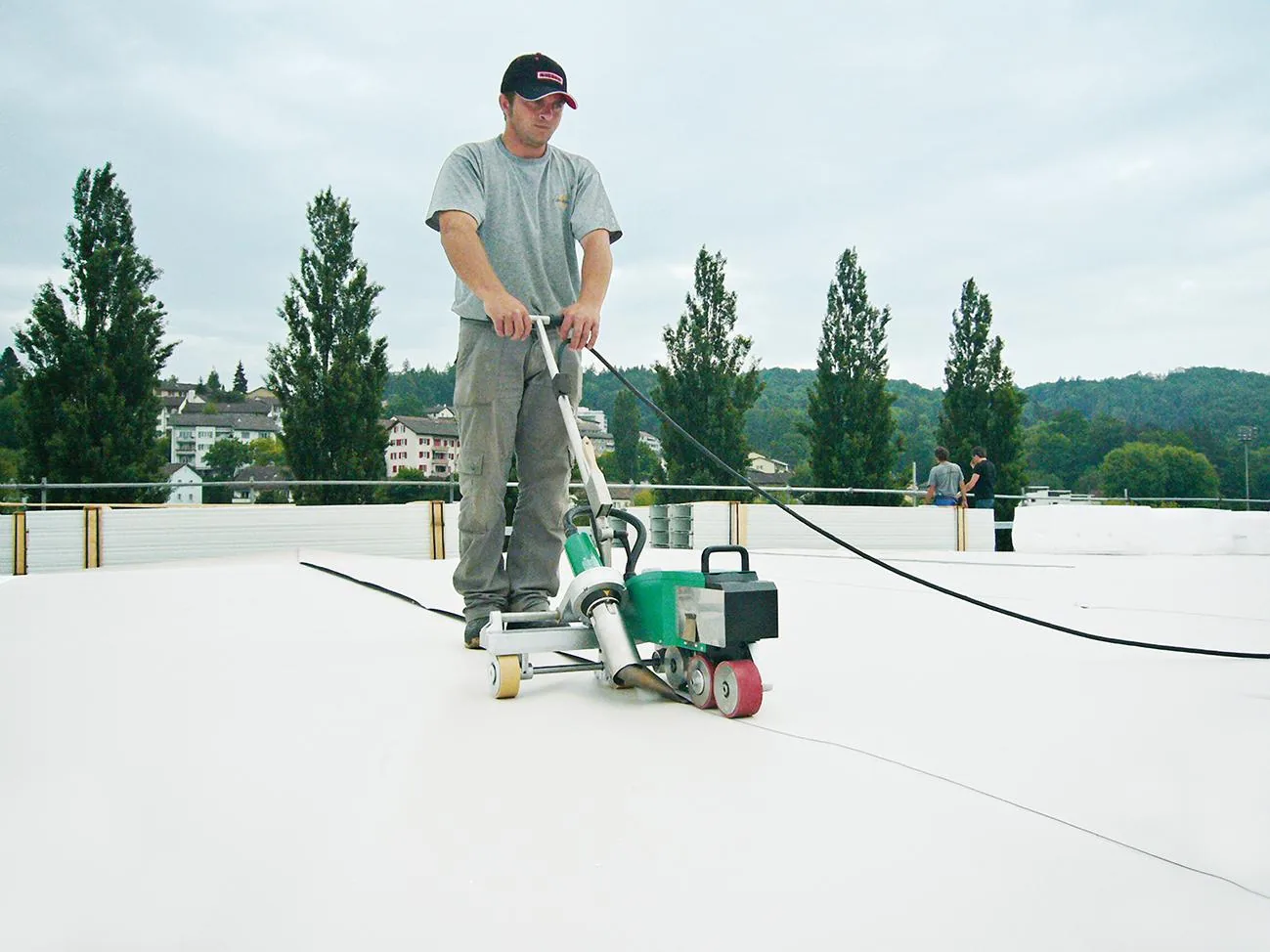
On a heat-welded single-ply roof, an open lap can be cleaned and rewelded where the membrane is sound, or covered with a welded strip or a patch when the lap edge is damaged. On an adhered system, an open lap is cleaned, primed and bonded with a compatible adhesive and a seam tape or cover strip. On modified bitumen, edges are cleaned, heated and sealed, and lap flashings are reinforced. On a metal roof, open seams are resealed or mechanically closed, and fasteners and clips are replaced where they have failed. In each case, the repair extends beyond the visible opening to bonded material on both sides, and the new seam is probed again after it cures. The same discipline applies to TPO roofing and PVC roofing seams.
Compatibility is the quiet requirement. A repair material must bond to the existing membrane, so we identify the membrane type before choosing a product, using manufacturer data, test cuts and the roof's history. Mixing incompatible materials can hide a seam for a season and fail in the next, so uncertain cases get a test patch and a pull check before the full repair.
When a seam problem is a membrane problem
A few open seams are repairs. Many open seams across a roof are a sign that the membrane has aged, shrunk or been installed poorly. We count open seams per zone, compare their distribution with the roof's exposure and age indicators, and test the membrane for brittleness and loss of flexibility. If the membrane is sound, repairs continue. If it is brittle or shrunken, the repair boundary widens, and the conversation moves to recover or replacement. The scope shows that decision with photographs, probe results and the reasoning, and it prices each option by area, access, penetrations and tenant hours. A roof recover is considered only if the insulation is dry.
Access, weather windows and sequence
Seam repairs depend on dry surfaces and suitable temperatures. Heat welding needs a clean, dry lap, and adhesives and tapes have minimum application temperatures and cure times. In a climate with frequent afternoon showers, work starts early, surfaces are checked for moisture before welding, and each repaired section is closed before the afternoon sky builds. We carry covers for open work, and we stop when conditions threaten. The schedule shows weather margin, and the daily log records conditions at each repair, which also helps if a seam is questioned later.
Access shapes the work as well. On a roof in Downtown Hollywood, where event days can close streets and affect deliveries and parking, equipment and materials arrive in small loads at planned hours. Roof hatches, ladders and safe routes to the seam are identified on the first visit. Where a seam runs under rooftop equipment, the unit may need to be lifted or the repair done around its supports. The plan lists each constraint, so the price reflects the work needed to reach the seam as well as the seam itself. Crews in the Downtown Hollywood area plan these windows with the property manager.
Ponding, flashings and seams together
Water that stands on seams accelerates failure, and seams that fail near flashings feed water into the wall. Ponding water and flashing failure are inspected at the same visit as seam failure, so the cause of a repeat leak is not left in place. Heavy June and September rain, above 8 inches in each month, gives seams plenty of work, as do the stormy weeks of mid-May to early July. Drains and scuppers are cleared and photographed so that the repaired seams are not asked to hold standing water.
Records and recheck
A seam repair is proven by a later probe, not by a dry afternoon. We record each repaired seam on the plan, probe it after cure and photograph it from the same position as the before image. After the next heavy rain, the interior is checked and the seams are revisited if water appears. Large roofs in areas such as the Washington Park Industrial Area, which the city is treating through a named redevelopment program, can have hundreds of feet of seams, and the plan shows which have been probed and which have not. The closeout file keeps the plan, the probe log and the photographs for future comparison.
Related Roofing Topics

