Need this roof reviewed?
Commercial flashing failure repair in Hollywood, FL: wall, curb, parapet and penetration flashings inspected, resealed or rebuilt, with photographs.
Most commercial roof leaks do not start in the middle of the membrane; they start where the membrane meets something else, and flashing is the detail that joins the two. Commercial Roofers Hollywood inspects and repairs failed flashings on commercial roofs in Hollywood, FL: walls, parapets, curbs, pipes, drains, skylights and edge transitions. The usual evidence is small: a pulled sealant bead, a gap at a counterflashing, a membrane turn that has lifted from its substrate, a rusted termination bar. The job is to find which of those details lets water in, repair the proper boundary around it, and photograph the result so the next inspection can compare.
Where flashing fails first
Flashing fails at points of movement and points of penetration. Wall flashings open where the roof and wall move differently, curb flashings loosen as equipment vibrates, pipe boots crack in sun and heat, parapet caps lose sealant at joints, and drain flanges lift when the membrane pulls away. We walk every transition and photograph each in a set order: the membrane turn, the termination edge, the counterflashing, the sealant and the fasteners. A detail that looks sound from a few feet may show a hairline gap when probed, so we probe a sample and record where the membrane is bonded and where it is not.
The interior stain is matched to these locations. Water often travels along a wall or a beam before dripping, so the stain may sit far from the opening. We compare the interior layout with the roof plan and start at the nearest transition upslope of the stain, then widen the search if the evidence calls for it.
Thermal movement and sealant
Roof surfaces in Hollywood run hotter than the air, which averages 76.1°F over the year and reaches about 89.9°F on August afternoons. That daily and seasonal cycle moves metal, membrane and masonry by different amounts, and flashing sits where the differences meet. Sealant that was applied as the only barrier dries, shrinks and cracks. Mechanical terminations that hold the membrane to a wall can loosen if fasteners back out. We examine both: whether the sealant is a secondary seal over a sound mechanical termination, or a primary seal over nothing. The repair rebuilds the mechanical termination first and adds sealant as a backup, not the reverse.
Masonry walls, parapets and older detailing
In the Harrison and Tyler historic districts, a blend of homes, shops and mixed-use buildings carries 1920s-era styling such as Mediterranean Revival, and the downtown business district follows a 1921 layout. A flashing on a masonry wall or parapet depends on the wall: open mortar joints, cracked stucco, spalled coping and failed caps all let water behind a flashing even if the flashing itself is sound. We examine the wall above the flashing, tap caps, check joints and note where a mason or a stucco contractor is needed. Roof-side flashing is repaired by us, and wall repairs are listed in the scope for others. Where a masonry wall is involved in the Harrison and Tyler historic districts, that coordination is part of the scope.
Where buildings along Hollywood Boulevard downtown or in the Johnson Street Business District share a parapet wall with a neighbor, a flashing may sit on a wall owned by someone else. We note whose wall it is before the repair is priced.
Reseal, rebuild or replace the transition
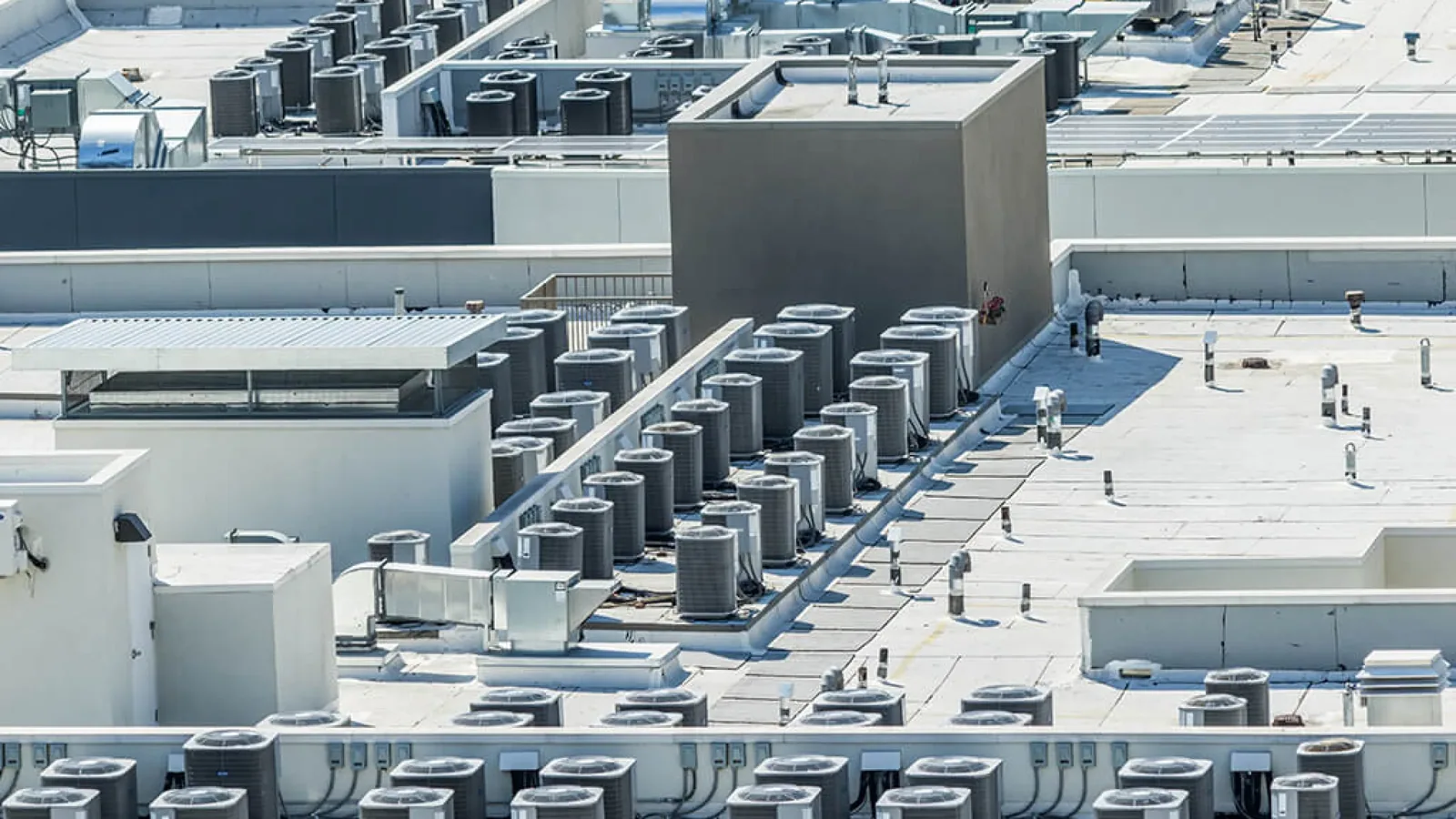
Not every flashing needs rebuilding. A sound flashing with dried sealant can be cleaned and resealed. A flashing with loose terminations can be re-secured with new fasteners and sealant. A flashing that has torn, rusted through or lost its bond to the substrate is rebuilt with new material tied into the membrane with a clean tie-in width. For equipment curbs, the repair may include raising the curb or rebuilding its flashing, a decision usually made together with the mechanical contractor, as with rooftop equipment curbs and supports. Each option is priced by area, access, number of details and the hours a tenant can give, and the scope shows what each option leaves behind.
Access shapes cost on flashing work. A parapet flashing on a tall wall may need a lift or scaffold, a curb flashing under a rooftop unit may need the unit lifted, and a flashing at a shared wall may need the neighbor's cooperation. We identify these constraints in the scope so that the price reflects the work needed to reach the detail, not only the detail itself.
Pipes, skylights and small penetrations
Small penetrations account for a large share of flashing leaks because there are so many of them. Plumbing vents, conduit, gas lines, refrigerant lines and antenna masts each pass through the membrane with a boot, a pitch pocket or a clamp, and each ages on its own schedule. Rubber boots crack in sun and heat, pitch pockets shrink and open, and clamps loosen. We inventory penetrations on the plan, photograph each, test boots by flexing and probing, and replace those that have lost their seal. Where lines run across the membrane, we check that supports lift them clear of the surface and that nothing rubs a seam.
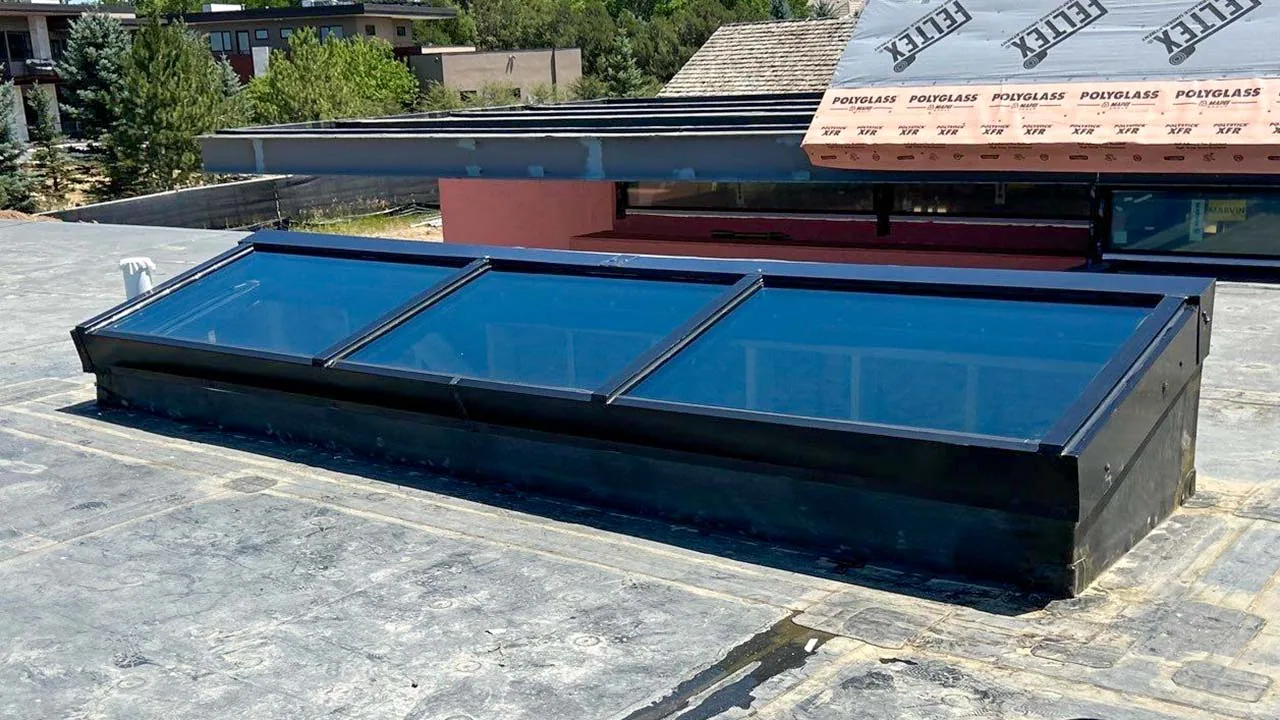
Skylights and smoke vents get their own review. The curb flashing, the dome or glazing seal, the gasket and the fasteners are checked for cracks and gaps, and leaks at the glass line are separated from leaks at the curb. Skylight and penetration flashing repair then follows the evidence: a new gasket, a rebuilt curb flashing, or a replacement unit if the frame has failed. When a dome is replaced, the surrounding membrane is inspected, since a leak at the dome often hides a second one at the curb.
Rain, ponding and flashing together
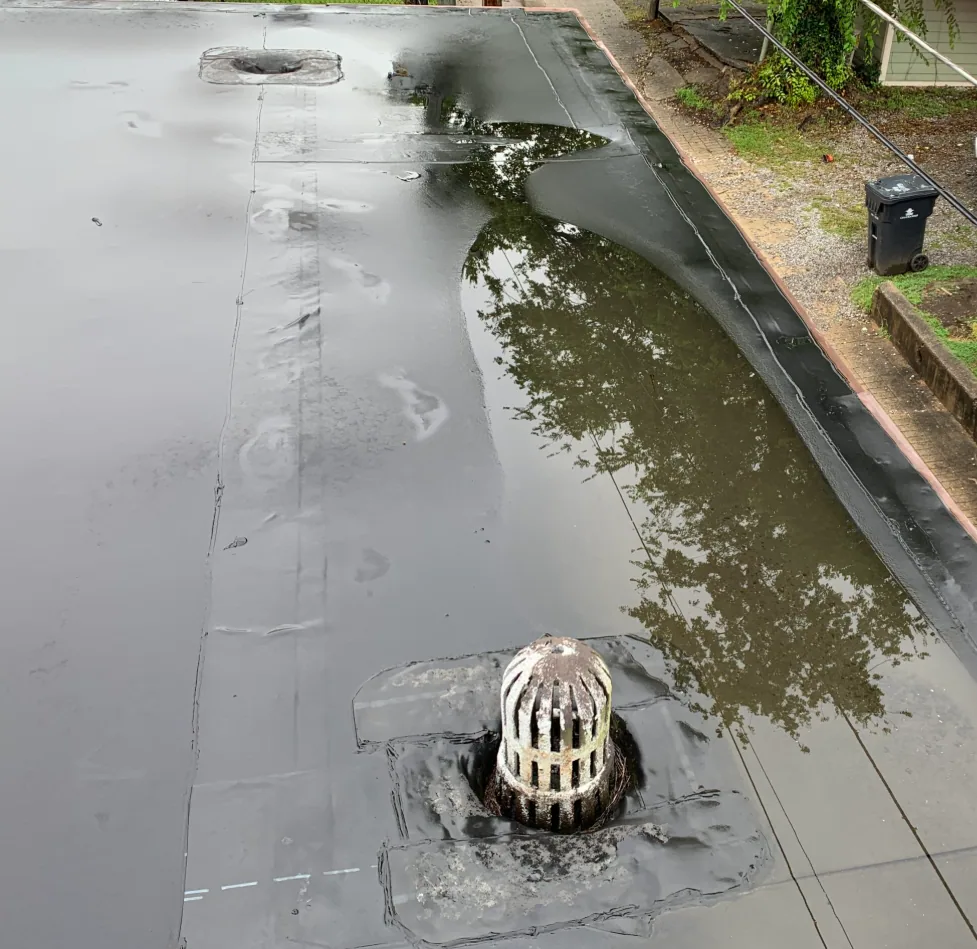
Rainfall above 8 inches in both June and September, plus the stormy weeks of mid-May to early July, test every flashing. Water that ponds against a wall finds the smallest gap, which is why ponding water and flashing failures often appear together. Wind-driven rain adds another path, one that wind damage can make worse by lifting edges and caps. We check drainage at the same visit as flashing, so a repeat leak is not left with its cause.
Verifying the repair
A flashing repair is verified by evidence, not by a dry day. We photograph the finished detail from the same position as the before image, record the products used and the termination method, and note the date. After the next significant rain, the interior is checked and the detail is revisited if water appears. For owners who prefer proof, a water test of the repaired section can be done on a dry day, with a person inside watching. The record goes into the file with the plan, so a later visit sees the history. Permit records are kept too, because the Building Division reviews roof work under the current Florida Building Code.
A related check applies to seam failure, since a seam that opens near a flashing can look like a flashing failure. Probing both avoids repairing the wrong detail.