Need this roof reviewed?
Inspection and repair of edge metal, coping, gutters and downspouts on commercial roofs in Hollywood, FL, with attention to attachment and sealant.
The edge is where a roof begins to fail in wind, and it is where water most often gets behind the membrane. Edge metal, coping and gutters hold the perimeter flashing in place, shed water away from the wall and protect the roof's last few inches from uplift. Damaging winds are most likely in South Florida between mid-May and early July, the stormiest part of the wet season, so Hollywood roof perimeters are tested every year.
Our inspection starts at the edge for that reason. We check how each piece is attached, how it is sealed, where it moves and where water leaves, and we write the findings down by roof elevation so repairs can be priced and sequenced.
Edge conditions also tell us about the rest of the roof. A stain line below a coping joint, a membrane that has pulled back from a wall or granules collected in a gutter each point to a mechanism: water behind the metal, shrinkage at the termination or surface wear upslope.
Attachment and Uplift
Wind lifts a roof from the perimeter inward. Pressure is highest at corners and edges, so the metal there has to be fastened to the building, not just to itself. We look at how drip edge is secured to the deck, how coping is attached to the wall, whether continuous cleats hold the outer face and what fasteners were used and at what spacing.
Missing or backed-out fasteners, bent cleats and gaps at joints show where uplift has begun. A section that moves under a hand test is already compromised, and a long run that rattles in light wind will not hold in a strong one. Wind and edge requirements come from the Florida Building Code, 8th Edition, and the building division reviews permitted work, so we confirm the standard that applies before specifying replacement metal.
Edge Metal, Coping and Fascia
The terms overlap, but the details differ. Drip edge is a metal flange at the roof edge that guides water into a gutter or off the roof. Coping caps the top of a parapet wall and sheds water outward. Fascia covers the face of the roof edge. Each has its own joints, fasteners and sealants. On a standing seam metal roof, the eave, rake and ridge trim are part of the panel system and are fastened to its specific clips and cleats.
We check joints between pieces for gaps, since water entering a coping joint runs down the inside of the wall. We check the underlap of metal onto the membrane, because a flange that stops short leaves the membrane's edge exposed. We look at the sealant bead at each lap and at wall terminations, where hardened sealant cracks as the metal expands and contracts. Where thermal movement is large, a joint needs an expansion detail, not a bead of caulk.
Long runs need planned movement. A coping run of many feet should have joints at set intervals, each covered by a splice plate or a flexible cap, so expansion shows up there and not as a split elsewhere. We look for runs that have no joints at all and for runs where the joints are bridged with rigid sealant that has cracked.
Gutters and Downspouts
Gutters collect the water that the roof edge sheds, and downspouts carry it to the ground. A gutter pulled away from the fascia, sagging between hangers or packed with debris overflows against the wall. A downspout that is disconnected or discharges at a foundation sends water where it does not belong.
Leaf and debris load varies with trees and neighboring buildings. Where debris collects, we recommend a cleaning interval and, if warranted, guards that are sized so they do not choke the flow in a downpour. A guard that clogs is worse than none, so we test it under running water.
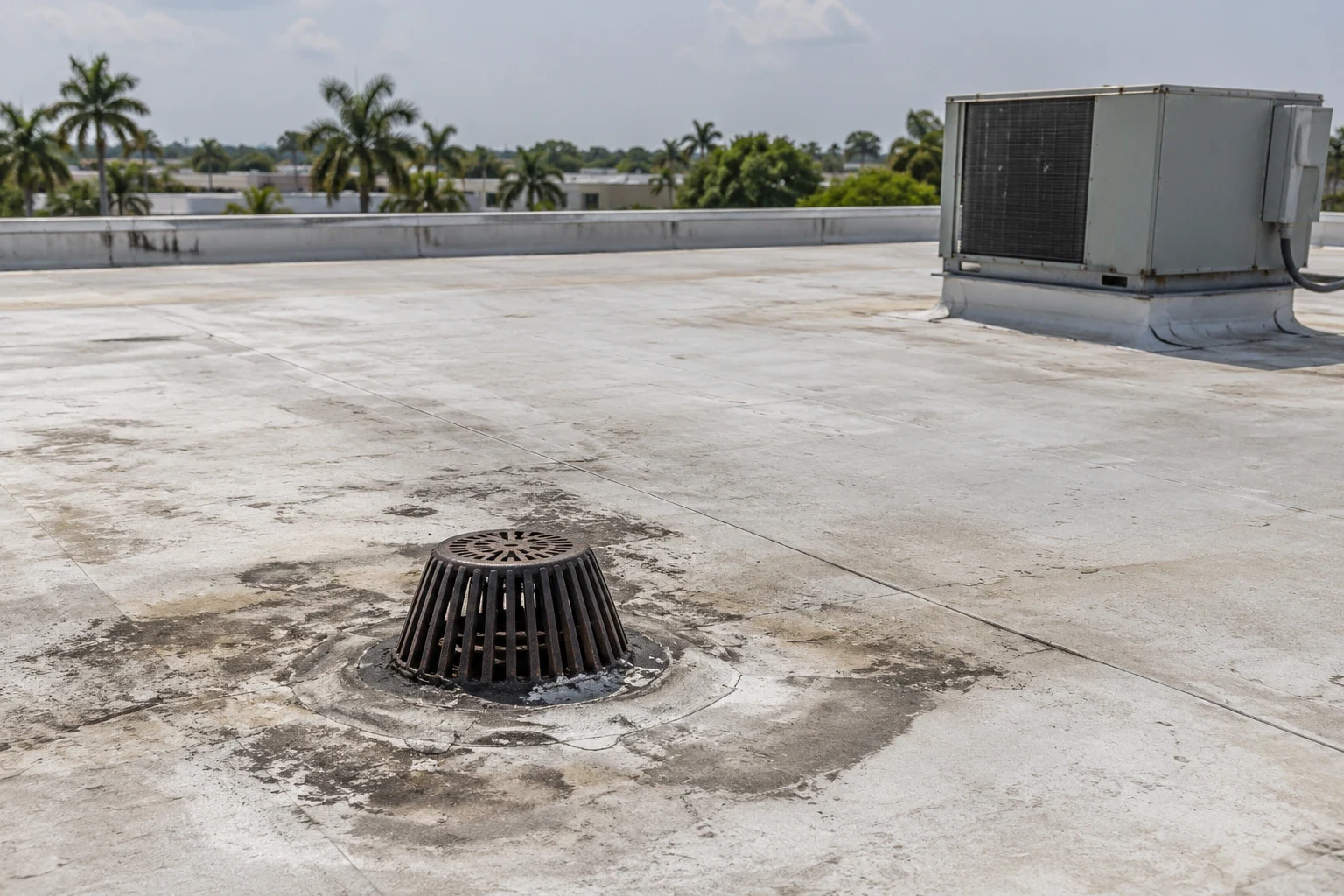
We clear and flow-test each run, check hangers and joints and trace the discharge point. For the rainfall that Hollywood receives, about 8.8 inches in June and 8.7 in September by the long-term normals, an undersized or blocked gutter fails quickly. Where a roof sheds to scuppers instead of gutters, we coordinate the work with our drain and scupper service so the whole path is clear.
Corrosion, Heat and Material Choice
Metal choice matters near salt air and under heavy sun. Steel without proper coating corrodes, aluminum resists rust but dents and moves with temperature, and stainless and copper cost more but last. Fasteners must suit the metal, since dissimilar metals in contact corrode where they meet. We identify what is on the roof, note corrosion at fasteners and seams, and recommend replacements that suit the exposure. Finish matters too: a factory-applied coating resists chalking and fading better than paint applied in the field, and a cut edge on coated metal needs touch-up so corrosion does not start there.
With August afternoons near 90 degrees, metal surfaces run well above air temperature, and daily expansion works at every joint. That cycle loosens sealant and fatigues fasteners. A building in the Hollywood Beach Business District near the Atlantic and one east of US-1, which the city flags in its flood-map review, may see different conditions than one farther west, and we read each roof for the wear it actually shows.
Repair and Replacement Sequence
Repairs follow the damage. Loose metal is re-fastened, open joints are resealed or fitted with covers, missing sections are replaced and failed cleats are renewed. If the metal is bent or corroded across a run, we replace the run, tie it into the membrane flashing and test the transitions. Temporary measures come first when weather threatens: a lifted section is strapped or fastened so it cannot tear the membrane while permanent metal is fabricated, which can take time.
Edge work often pairs with commercial roof repair or a recover, because the membrane must be flashed correctly into the new metal. Cost drivers include linear feet, height, lift or scaffold access, the metal and finish, and whether the membrane at the edge is sound. If the membrane under the old metal is wet or brittle, the scope grows, and the proposal shows that line separately so the owner sees it before work begins.
Access, Records and Districts
Perimeter work puts crews and materials at the building edge, so we plan pedestrian protection, closures and deliveries before starting. In the Downtown Hollywood district and along Hollywood Boulevard, city event closures can affect deliveries and parking, and we schedule around them.
The closeout record lists each run, the metal, the fasteners and sealants, photographs of attachment details and any items left on watch, and a spring maintenance walk checks them again.