Need this roof reviewed?
GAF commercial roofing systems in Hollywood, FL: how EverGuard TPO and self-adhering SBS assemblies are installed, repaired and maintained in heat and rain.
The name on the roll tells a property manager less than the way the sheet is attached, welded and flashed. A GAF assembly is a family of choices, not one product: a heat-welded thermoplastic sheet on one building, a self-adhering modified bitumen cap on another, each with its own insulation, fasteners and details. Hollywood, FL puts these assemblies through August highs near 90 degrees and a long rainy season, which makes drainage, seams, edges and transitions the details worth examining first. GAF makes a defined set of commercial systems, and we install, repair and maintain them from the first observation on the roof to the written scope.
System families on commercial roofs
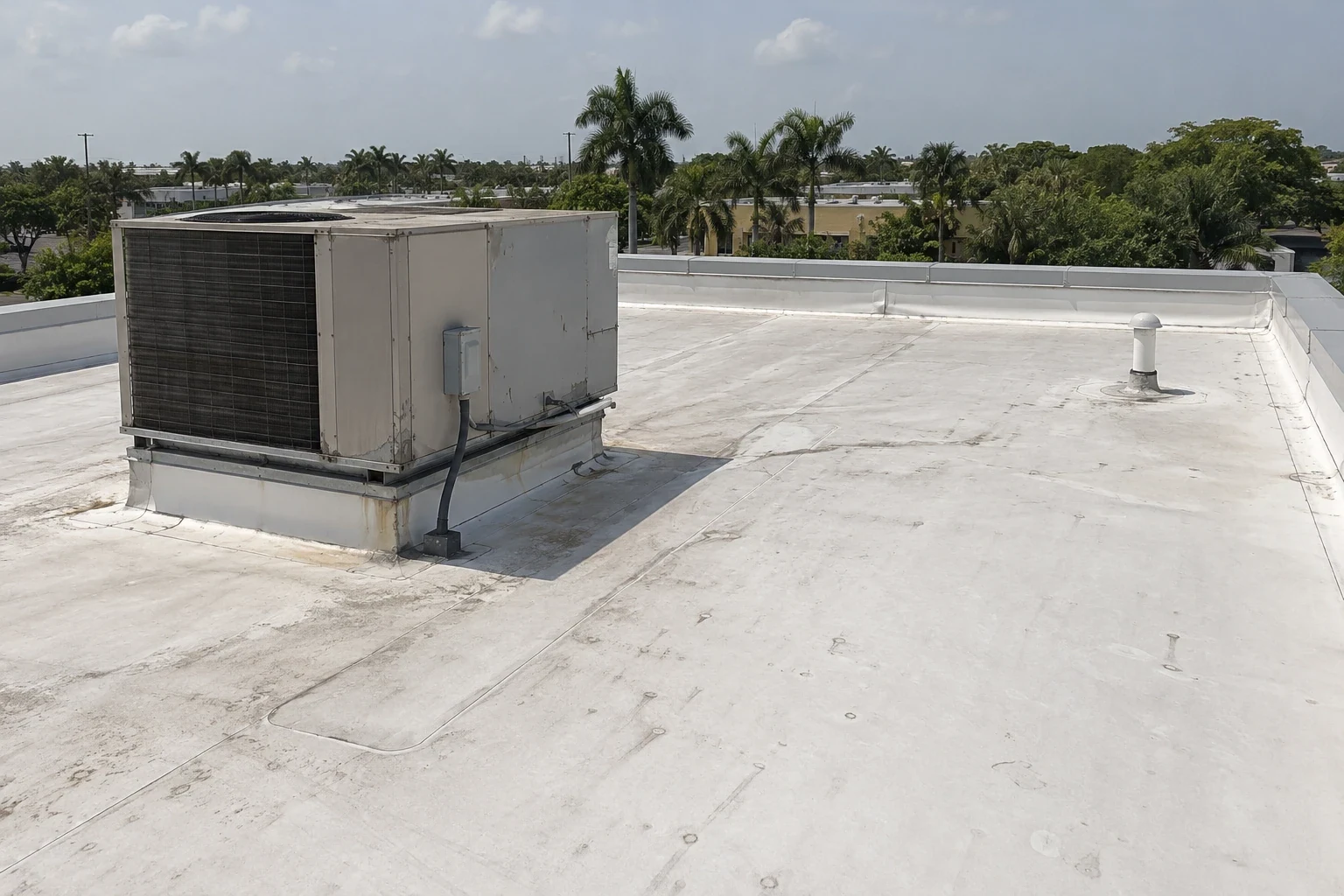
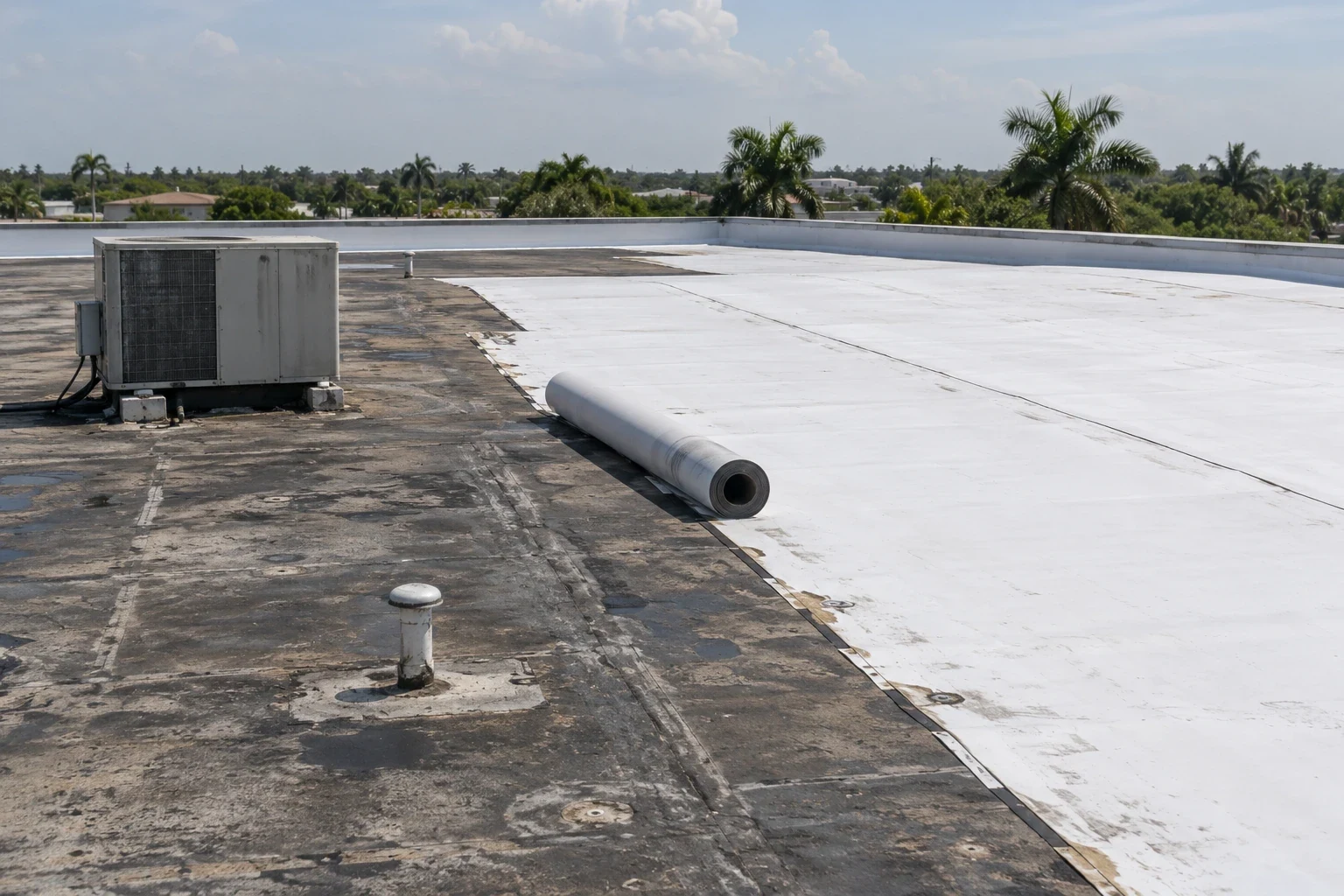
For low-slope commercial work, GAF is best known for its EverGuard TPO single-ply membranes and for modified bitumen products, including a self-adhering SBS system under the Liberty name. TPO sheets are welded with hot air at the seams, and the white surface reflects sunlight. Modified bitumen builds a roof from layered sheets, with seams and laps sealed by heat, adhesive or self-adhering edges.
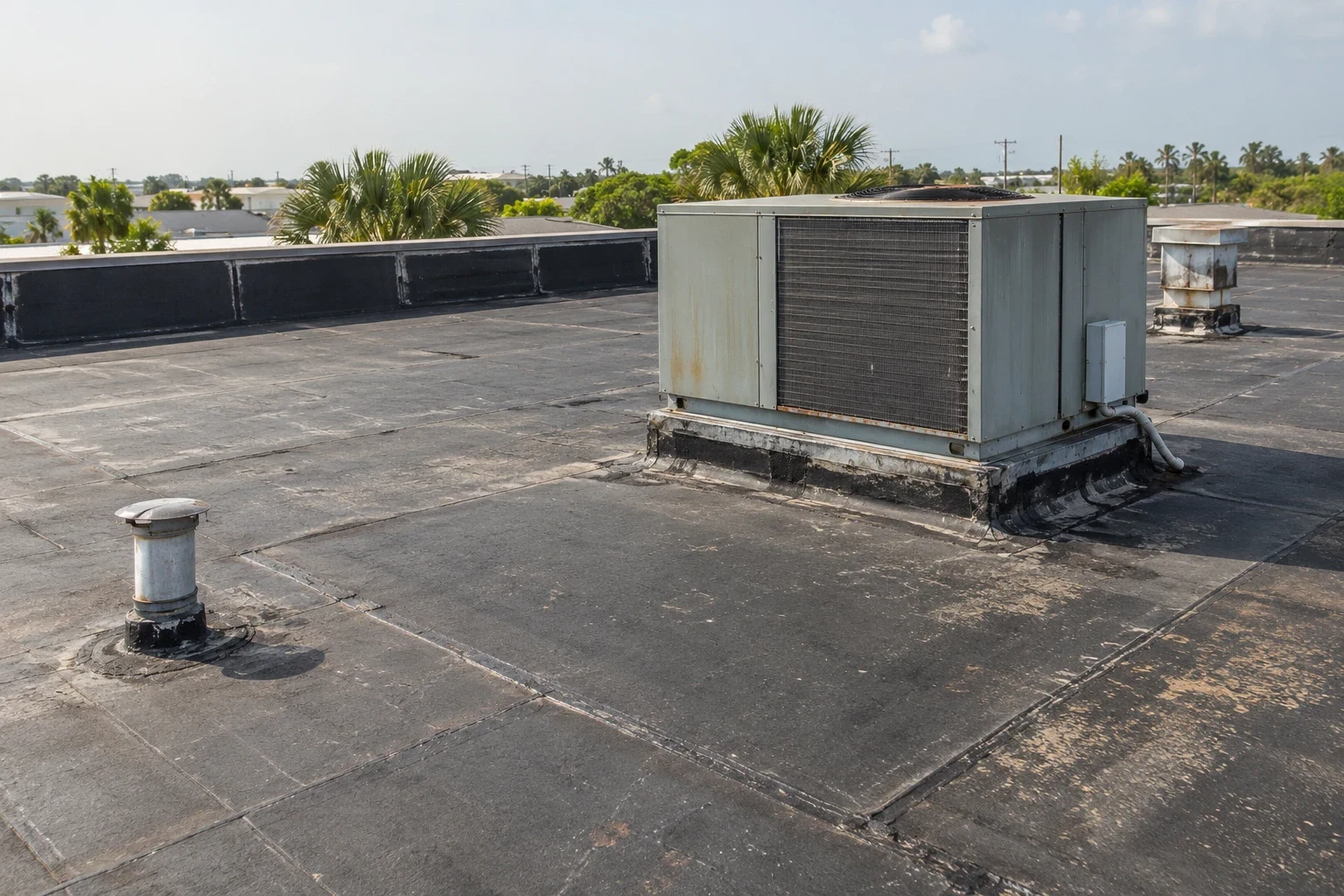
The two families behave differently. A TPO sheet depends on the quality of its welds and the stability of its flashings. A modified bitumen roof depends on lap adhesion, surfacing and the layers beneath. Our TPO roofing and modified bitumen roofing work follows the details each family needs, and we say which one the building's condition favors.
Surface and color matter in local heat. A white membrane lowers surface temperature compared with a dark one, while a granulated cap sheet protects the bitumen beneath from sun. On any roof with rooftop equipment, including one in Downtown Hollywood, the walk surface around units also needs protection, because foot traffic wears either family at the same paths.
Attachment methods and substrate condition
A GAF TPO sheet can be mechanically attached with fasteners and plates, fully adhered to the substrate or installed over ballast, and the choice depends on the deck, the wind exposure and the insulation. A self-adhering SBS membrane bonds to a prepared base without torch or hot asphalt, which can suit occupied buildings where open flame is a concern.
Each method depends on the substrate. Wet insulation will not hold an adhesive, a dusty surface prevents a bond, and a deck with weak fastener pull-out cannot support plates. Before any scope is written, we test moisture, check the deck and pull sample fasteners where practical. Product data and attachment details are confirmed with the permit, since Hollywood reviews reroof plans under the Florida Building Code, Eighth Edition (2023).
Wind and edge conditions govern fastening. Perimeters and corners see higher uplift than the field, so attachment is tighter there, and edge metal is detailed to hold the membrane in place. We check each edge condition on existing roofs, since a loose cap or a lifted termination is where wind finds a way.
Seams, flashings and prefabricated accessories
Most leaks on a single-ply roof start at a detail, not in the field. Walls, curbs, pipes, drains and corners are built from flashing pieces welded or adhered to the main sheet, and each joint is a place where heat movement and water can test the work. We probe welds, check termination bars and sealant, and look at the fit of prefabricated corners and boots against the real curb size.
On modified bitumen, the laps and the flashing plies carry the same risk. We check lap edges for lifting, look for granule loss at the surface and trace any blister to its cause before opening it. Repairs use materials compatible with the installed system. A mismatch, such as an incompatible mastic over a thermoplastic sheet, can fail within a season.
Penetration clusters deserve patience. Several pipes and conduits within a small area leave little room for a clean weld, and a pocket or a prefabricated boot may fit better than a hand-cut patch. Whichever detail we pick, the aim is to give the flashing as much clean surface to bond to as the corner allows.
Heat, rain and drainage in Hollywood
On the thermal side, NOAA's August average daily maximum for Hollywood is 89.9 degrees; on the water side, June and September normals are 8.84 and 8.67 inches. The National Weather Service names mid-May through early July as South Florida's stormiest stretch, when damaging winds, tornadoes, hail and flooding are the most likely events, so membrane edges and terminations get checked before it begins. Those conditions show where an inspection should look first.
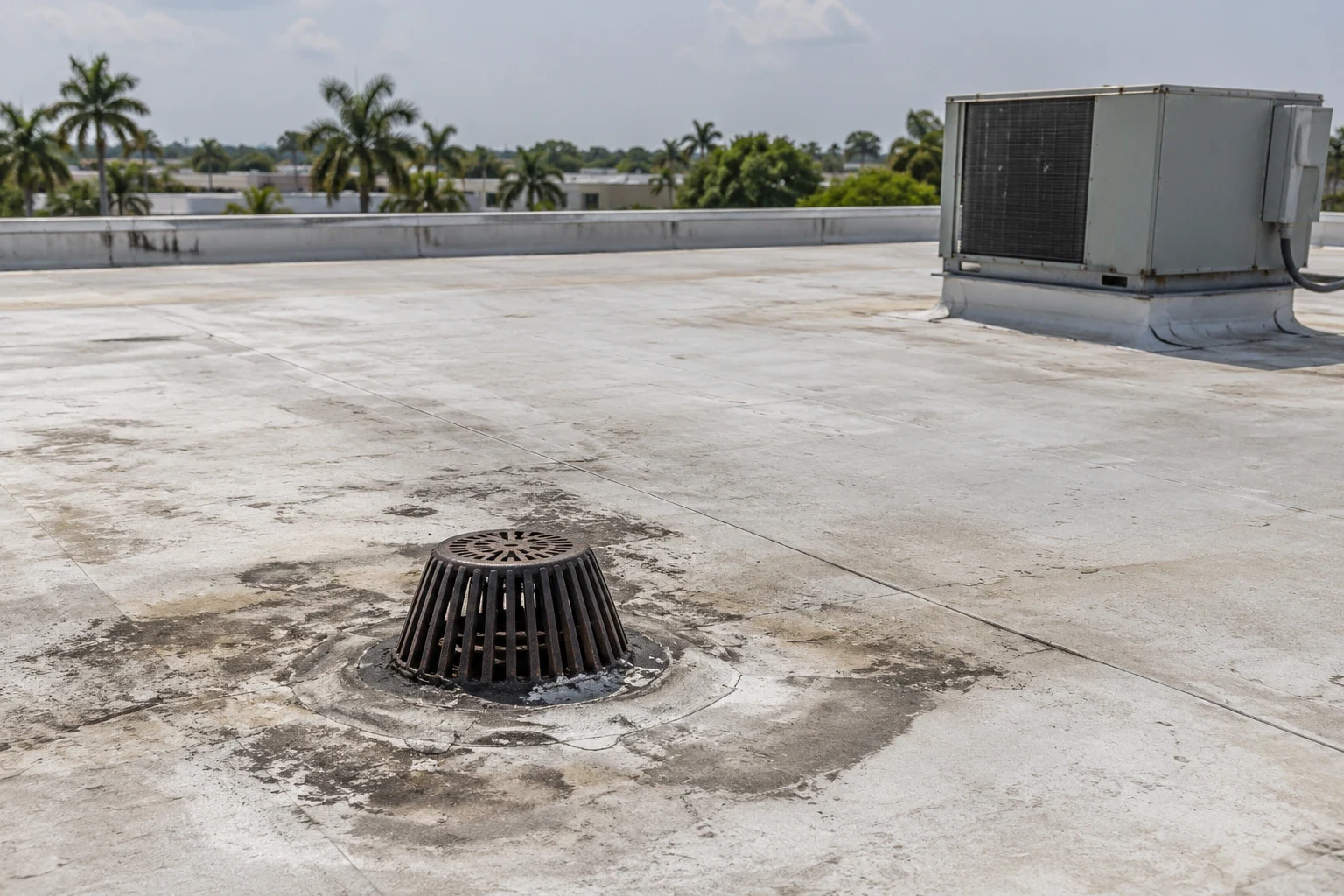
Drains, scuppers and overflow openings come first, followed by edge metal and the transition between roof areas. We measure ponding depth and duration, and our work on drains and scuppers aims at a roof that sheds water within a reasonable time. Reflective TPO surfaces also need cleaning, since dirt reduces the surface's ability to shed heat, a point that matters for a building near the Hollywood Beach business district as much as for one inland.
Recover, tear-off and compatibility with existing layers
When a GAF system is considered over an existing roof, the first question is whether the base can accept it. A recover needs dry insulation, sound attachment and a surface that bonds. We cut test openings, count layers and check that the structure can carry the added weight. If the existing roof fails those tests, a tear-off is the sound path.
Compatibility also governs repairs. A thermoplastic sheet and an asphalt-based product should not touch without a separating layer, and a self-adhering membrane needs a clean, primed surface. We read what is on the roof before choosing materials, and the proposal lists each layer and its purpose.
Cover boards and insulation are part of the system. A firm cover board under a membrane resists hail and foot traffic, and the insulation type must suit the attachment method. The City lists a variety of commercial settings, from Downtown and the beach districts to the Johnson Street Business District, so the assembly under the sheet is specified for the building, not for the brochure.
Warranty terms and the maintenance record
A manufacturer's warranty carries conditions, and those conditions differ by system and by document. The document sets the terms, so we ask the owner for it and list its requirements in the file. Common items include notice periods, approved procedures for repairs, limits on penetrations and expectations for maintenance.
The maintenance record supports every one of them. Dated photographs, drain cleaning, sealant checks and post-storm walks show that the roof was cared for. Our roof warranty management keeps those papers together. For comparison with other thermoplastic and bituminous systems, owners can review Carlisle SynTec and Holcim Elevate assemblies on the same criteria.
Related Roofing Topics