Need this roof reviewed?
Johns Manville commercial roofing in Hollywood, FL: single-ply, built-up and modified bitumen assemblies with polyiso insulation, checked for moisture and heat.
Insulation is the part of a Johns Manville roof that nobody sees and everybody pays for, and it is often the first layer to be ruined when a seam opens. JM supplies single-ply membranes, built-up and modified bitumen products and polyisocyanurate insulation, so a JM roof is as likely to be defined by what lies under the surface as by the sheet on top. In Hollywood, FL, long summer heat and seasonal downpours push water and temperature through every layer, and the drying potential of an assembly matters as much as its first cost. We start by identifying the layers, then judge the roof by how each one is holding.
Membranes, bituminous systems and insulation
Johns Manville is known on commercial roofs for TPO, PVC and EPDM single-ply membranes, for built-up and modified bitumen systems and for ENRGY 3 polyiso insulation boards. A single-ply roof may be mechanically attached, adhered or ballasted over polyiso. A bituminous roof builds plies in hot asphalt or cold adhesive and finishes with a cap sheet or a surfacing.
These are different failure profiles. A thermoplastic seam fails at a weld, a bituminous roof fails at a lap, a blister or a split, and either one fails at a flashing. Our built-up roofing and modified bitumen roofing work follows those mechanisms, and we describe which one the roof shows before suggesting a repair.
Compatibility rules the layers. Asphalt products, thermoplastic sheets and foam boards do not all tolerate contact with each other, and a separator sheet or a cover board is sometimes needed. We read the existing layers before choosing a repair material so nothing is placed where it will attack its neighbor.
Polyiso boards, thermal performance and moisture
Polyiso is a rigid foam board with a foil facer, widely used under low-slope membranes. It insulates well when dry. When it takes on water, its performance drops, the facer can deteriorate and the board can lose strength, so a small leak that goes unnoticed can degrade a large area. Board joints, fastener holes and edges are where water enters first.
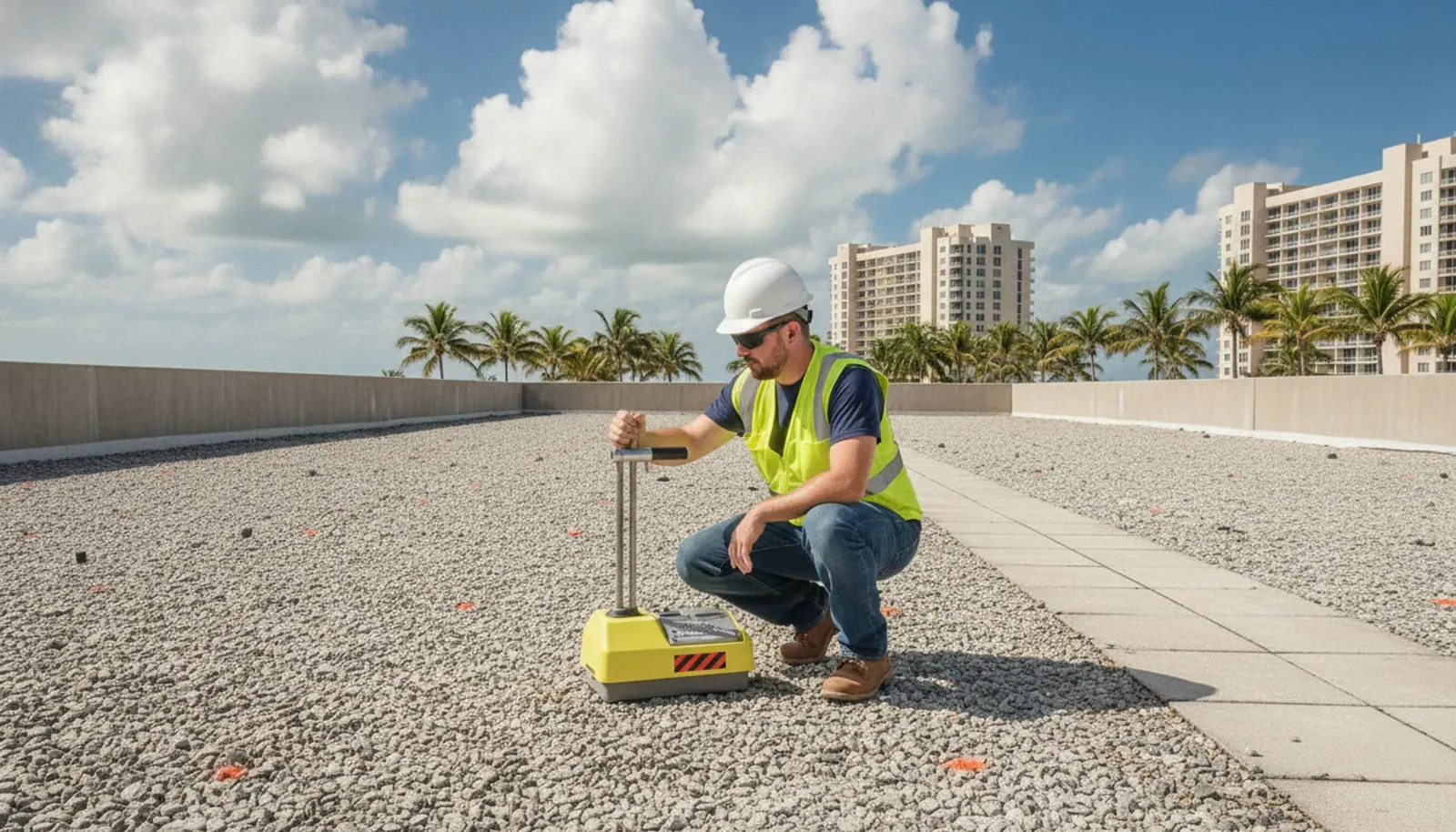
We find wet insulation with an infrared moisture survey and confirm with cores that show board type, thickness and moisture depth. The wet share of the roof guides the choice between a contained repair and replacement. Where new boards are installed, a cover board adds a firm face for adhesives and protects the insulation from hail and foot traffic.
Tapered insulation is a common companion in this family. Boards cut to a slope create a fall toward drains and eliminate low areas, and the layout drawing shows where each thickness sits. We check an existing taper by measuring water depth after rain, since a taper that stops short of the outlet leaves a pocket at the end.
Built-up and modified bitumen behavior in heat
Bituminous roofs respond to heat with softening at the surface, granule loss on cap sheets and movement at laps. Built-up systems rely on multiple plies for redundancy, which is useful when one ply is damaged. Modified bitumen adds polymer to the asphalt for flexibility, and laps are sealed with heat, adhesive or self-adhering edges.
At the Hollywood station the August daily high averages 89.9 degrees, and a dark bituminous surface in full sun runs hotter than the air above it. We look for blisters, ridging, alligatoring and exposed reinforcement, then trace each to a cause. A blister is not opened until we know what it holds, since air, moisture or a failed bond each calls for a different response.
Surfacing is the roof's sunscreen. Gravel, granules or a coating shield the asphalt from ultraviolet light, and where that cover has worn away the layer beneath ages quickly. A surfacing repair on a sound roof is far less costly than a repair of the plies that follow when it is ignored.
Single-ply seams, flashings and accessories
On a JM single-ply roof, the seams are the first test. Thermoplastic sheets weld with hot air, EPDM joins with tape or adhesive, and every flashing is built from pieces made for the sheet. We probe seams along their full length, check termination bars and sealants and examine prefabricated corners and boots against the actual curbs.
Repairs use compatible materials and procedures: a cleaned, tested and welded patch on thermoplastic, a primed and taped splice on EPDM. Mixing materials, such as an asphalt mastic over a thermoplastic sheet, shortens the repair's life. The record notes the location, cause and method, so the next inspection checks the same spot.
Mechanical attachment leaves a pattern of fasteners and plates beneath the sheet. A fastener that has backed out raises the membrane and wears it from below, so we look for ridges, fluttering and plate lines. A short run of fasteners can be reset, while widespread backout signals deck or attachment problems.
Drainage, wet-season exposure and edge detail
NOAA logs 8.84 inches of rain for Hollywood in June and 8.67 in September, and the National Weather Service treats mid-May through early July as the part of South Florida's wet season when severe weather is most likely, so a modified bitumen roof is checked at its laps and flashings before that window opens. Roofs in that climate depend on drains that work. We measure ponding depth and duration, clear and flow-test drains and scuppers and check that overflow openings sit at a safe height.
Edges follow drains in priority. Coping, metal returns and terminations take wind and water first, and we tighten or replace what has moved. For a building in Downtown Hollywood or elsewhere in the city, the same checks apply, and the findings go into the file with photographs.
Owners along Johnson Street from 56th Avenue to US-441 and those on Hollywood Boulevard share a sky but not a roof, so each building is drained, measured and recorded on its own terms. A shared standard keeps the checks consistent without assuming the answers match.
Repair, recover or replace, with comparison
A JM roof with dry insulation and isolated defects is a repair candidate. A sound roof that can carry another layer may accept a recover. A roof with widespread wetting, repeated failures or tired plies points to commercial roof replacement, scoped with insulation and cover board matched to the building. Product documentation and attachment details are checked first, because reroofing in Hollywood is governed by the Florida Building Code, Eighth Edition (2023), and reviewed by the Building Division.
For comparison, owners can review Soprema for bituminous systems and Sika Sarnafil for PVC, applying the same criteria: layers, seams, flashing method, repairability and maintenance. The written scope states why one family fits the roof better than another.
Records tie the decision together. A dated file with moisture maps, photographs of each layer and a list of repairs shows whether the roof is holding or slipping, and it gives the owner evidence to compare against the first condition report.