Need this roof reviewed?
Commercial roof repair, replacement and maintenance on the Sistrunk Boulevard and 7th Avenue corridors of Fort Lauderdale, FL, for street-front buildings.
On a street meant for walking, the roof edge is closer to people than it is on a highway strip, and a loose coping cap or a spilling gutter reaches a sidewalk quickly. Fort Lauderdale's Northwest Regional Activity Center plan centers on the Sistrunk Boulevard and 7th Avenue corridors, inside a broader northwest CRA area, and the City describes design standards and zoning rules meant to allow a mix of uses along them. Business, shopping, cultural and entertainment uses are all part of the planning vision. For a roofer, uses like these ask different things of a roof: a small retail roof, a mixed-use roof and a larger assembly roof each bring a different drainage plane and a different public edge, and the first walk sorts them before any repair is chosen.
A Walkable Corridor Changes the Roof Edge
The planning vision calls for a bicycle- and pedestrian-friendly urban corridor, and that goal puts attention on what happens at the top of the wall. Edge metal, coping, gutters and downspouts either carry water away from the sidewalk or drop it onto it. We check each of those on the first walk, noting loose fasteners, open joints, sagging gutter runs and downspouts that discharge across a walking path.
When work requires a lift or hoist, the staging plan protects the sidewalk: a fenced drop zone, a marked pedestrian route and a spotter where trucks cross it. Material comes in outside the busiest hours the owner identifies, and debris leaves the roof through a closed chute or a controlled hoist, not by hand over the edge.
Rainwater leaving a roof edge has to land somewhere, and on a corridor with outdoor seating, planters or bike lanes, a failed gutter creates a visible problem within a storm. We note where each downspout discharges and whether the receiving surface is built to take it, and we report that alongside the roof findings.
Heat, Rain and the Street-Front Parapet
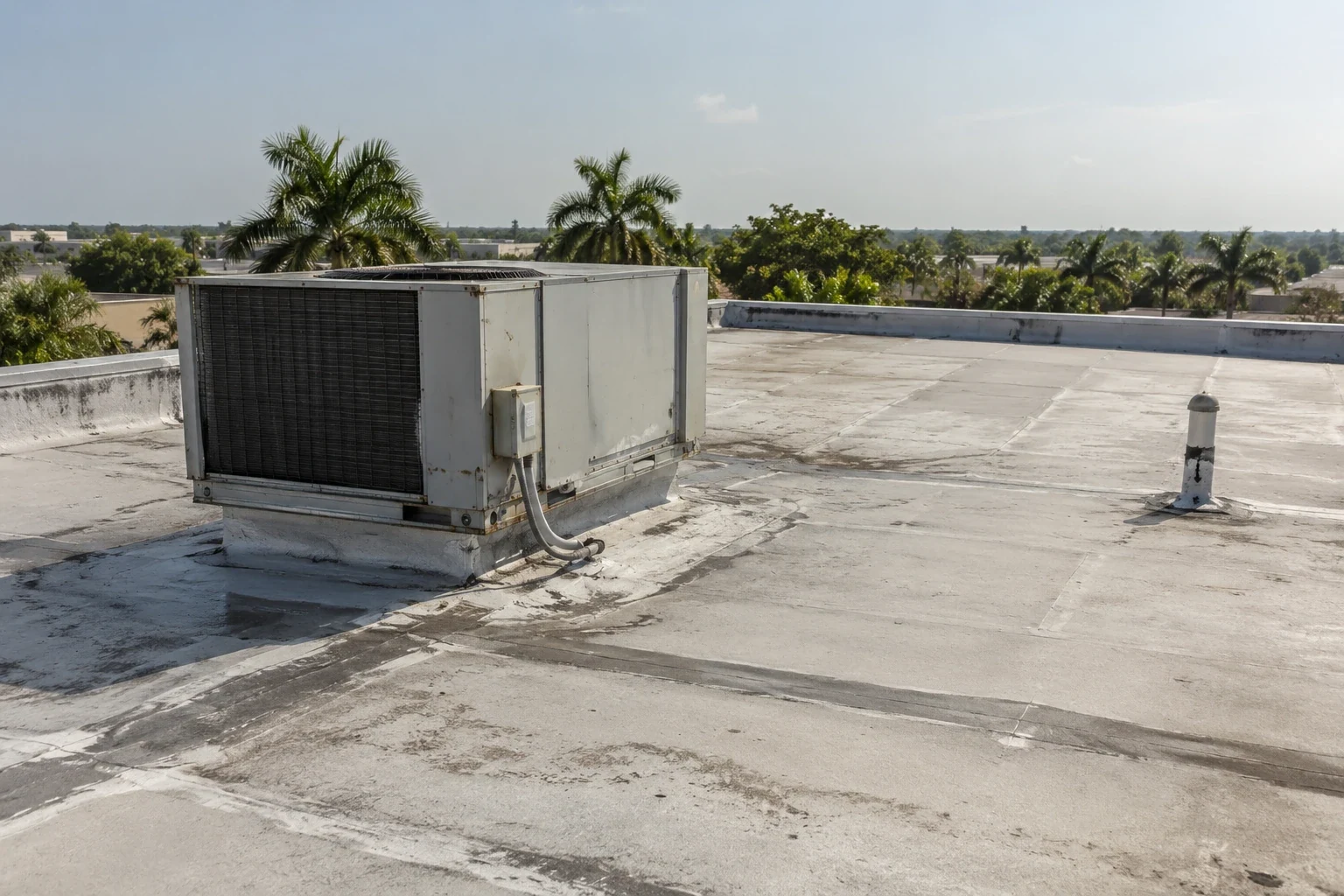
Hollywood's NOAA station shows August highs near 89.9°F on average and more than eight inches of rain in each of June and September. A parapet roof meets that cycle at its base, where the membrane turns up the wall and where water that cannot leave quickly sits against the flashing. Thermal movement pulls at the termination edge in the hot months; ponding tests it in the wet ones.
Those figures tell us to look at the wall base, the counterflashing and the outlets before looking at the open field. A low-slope roof that drains well can carry a lot of weather; one that holds water at a parapet will show its first leak there.
Drainage on a street-front roof often runs toward the rear or a side wall, where a scupper or downspout discharges near a service lane. Every drainage path is followed from the roof surface to its discharge point, since a clean strainer helps little when the downspout below is blocked or lands on a surface that cannot take the flow. Overflow openings are checked for clearance as well, because they are the last defense when a primary outlet fails.
Mixed-Use and Assembly Roofs
A building with retail below and offices or residences above has a roof that serves occupied space at every level, so a leak is reported by someone quickly. A cultural or entertainment venue may have a large span, long drainage runs and equipment loaded on the roof. The first walk covers the following on any of those types.
- Outlets, scuppers and overflow routes, with strainers checked
- Wall bases, terminations and counterflashing
- Penetrations, curbs and equipment supports
- Seams, laps and patched areas
- Signs of trapped moisture or compressed insulation
Where equipment is screened or set back by a design requirement, we also look at how the screen connects to the roof, since a screen fastened through the membrane is a common source of slow leaks.
Design Standards and Roof Decisions
The City describes design standards and zoning regulations for the corridors, and an owner who changes parapet height, rooftop equipment or visible edge details may need to check what applies before the work is designed. That review belongs to the owner and the owner's architect; we ask which standards apply and draw the roof scope to fit them.
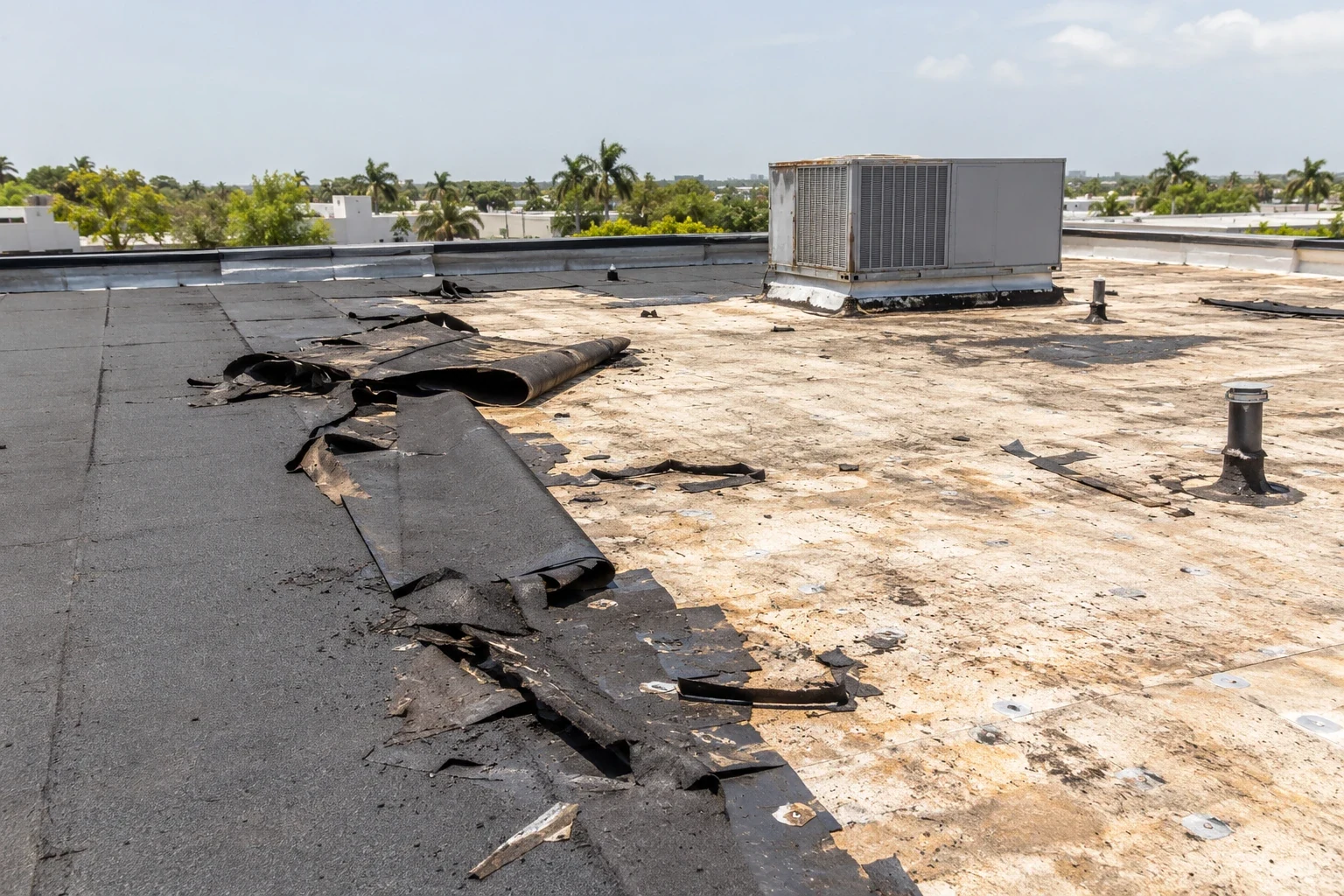
The roof choice itself follows the evidence. A confirmed defect with sound surroundings calls for commercial roof repair. A dry, attached membrane may take a coating. Wet insulation or widespread seam failure points toward replacement. Access, roof area, penetrations, wet-area extent and the tenant schedule set cost and timing.
Tenant Hours and Event Days
A corridor planned for shopping, culture and entertainment has days when foot traffic peaks. We ask the owner about event dates, delivery hours and the times when the front of the building is busiest, then place noisy or lift-heavy work outside them. Where tenants share the roof, the manager receives the daily work area and hours so each tenant can plan around them.
An occupied building is reroofed in sections, each closed to weather before the crew leaves, with interior protection placed under any ceiling likely to be disturbed. If an active leak is the reason for the visit, temporary protection goes in first, and the permanent repair is scheduled once the water path is traced. That order keeps customers dry and keeps the repair based on evidence.
Permits, Records and Neighbors
Reroof permits go to the local building department, which checks them against the Florida Building Code, 8th Edition (2023), listed by the state commission as effective December 31, 2023. Scope documents are written to that standard, and stage photographs show what came off and what went.
A property owner with buildings in the Central City CRA or on the NW 7 Avenue Corridor in North Miami can keep one file format across sites. A preventive maintenance plan keeps outlets and edges checked before the wet season.
After each visit the owner receives locations, photographs and a short list of items to watch, so the next manager can compare conditions instead of starting over.