Need this roof reviewed?
Commercial roof repair, replacement, coating and maintenance for strip centers, office buildings and mixed-use properties in Hallandale Beach, FL.
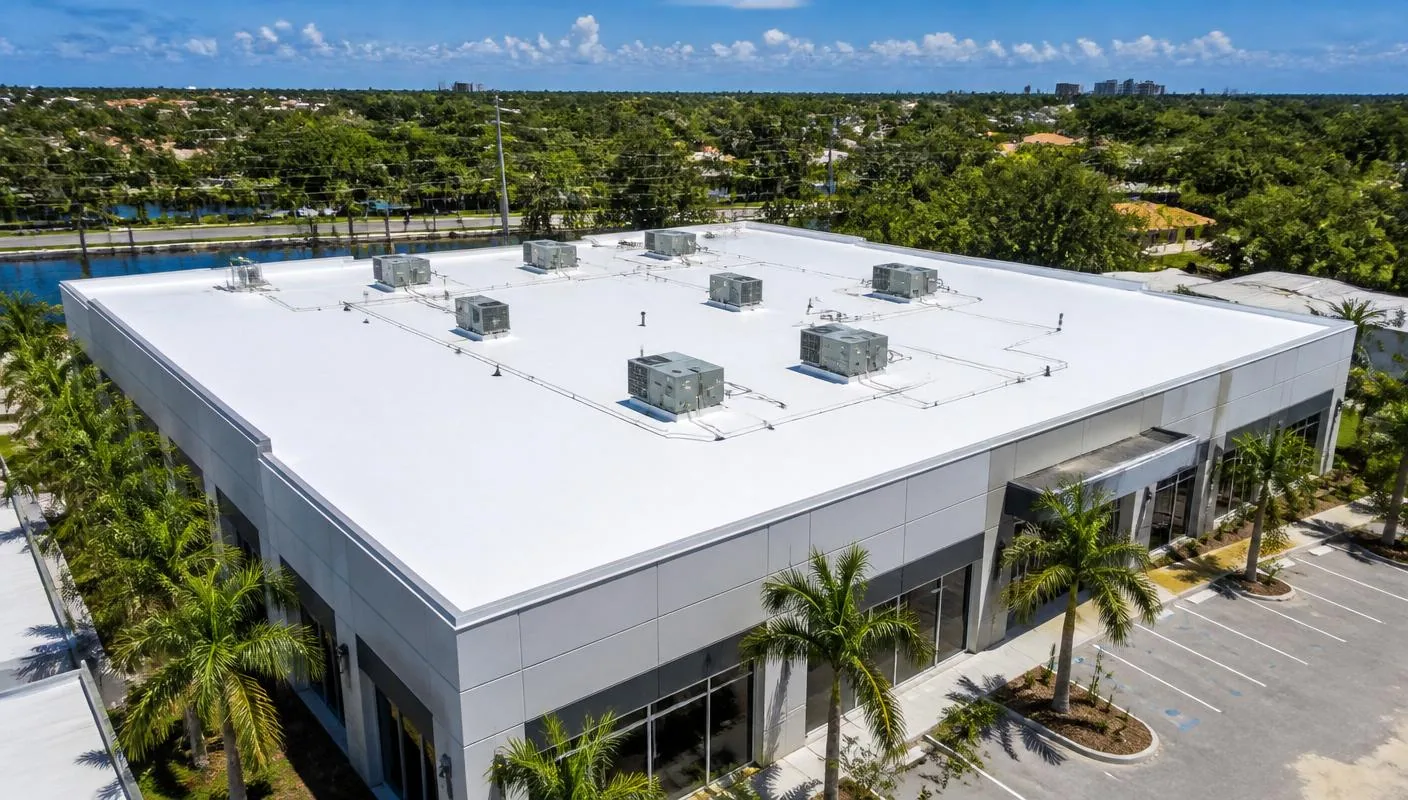
A strip center roof and an office building roof share the same enemy, which is water that lingers. In Hallandale Beach, the City's master plan places its densest commercial activity along East Hallandale Beach Boulevard, where strip centers and office buildings sit close together, and those are the buildings we inspect and repair: flat or low-slope roofs with rooftop units, long parapet walls and drains that need to keep working through a South Florida summer. We repair, replace, recover and coat roofs on these building types, and we begin each job with a roof walk that records what water is doing before anyone prices a fix.
Strip Centers, Offices and Beachfront Towers
The City's master plan describes the commercial density on East Hallandale Beach Boulevard as strip centers and office buildings, and it identifies the beachfront A1A towers as the city's highest residential concentration. Those are three different roofing problems. A strip center tends to have a long, continuous roof divided by firewalls and shared by several tenants, so a leak in one bay can travel along the deck before it shows up in another. An office building usually carries more mechanical equipment, and every curb and pipe is a place where flashing has to keep sealing.
Residential towers near the coast have their own demands, because a high roof is exposed to stronger wind and driven rain than a roof on a low building. We look at each building for what its drainage, wind exposure, equipment load and tenant use require. A parapet that traps water behind it asks for different scuppers than an open edge, and a roof with a dozen rooftop units asks for a different walkway plan than one with two.
Summer Heat and Heavy Rain on Low-Slope Roofs
NOAA normals for Hollywood, the market city, put August afternoons at an 89.9-degree average high and rainfall near 8.8 inches in June and 8.7 in September. Those market-wide numbers describe the conditions a Hallandale Beach roof has to handle. Heat raises surface temperature and pushes membranes through daily expansion and contraction, which tests seams, laps and the edge condition where metal meets membrane.
Then comes the rain. South Florida's wet season is at its stormiest from mid-May into early July, in the National Weather Service's account, which is when damaging wind, tornadoes, lightning, hail and flooding become most likely. A roof that has ponding at a drain bowl or standing water at a perimeter is carrying that load for hours, and the water finds any open seam or cracked sealant joint. We check outlets first because blocked drainage multiplies every other weakness in the assembly.
Reading the Roof Assembly Layer by Layer
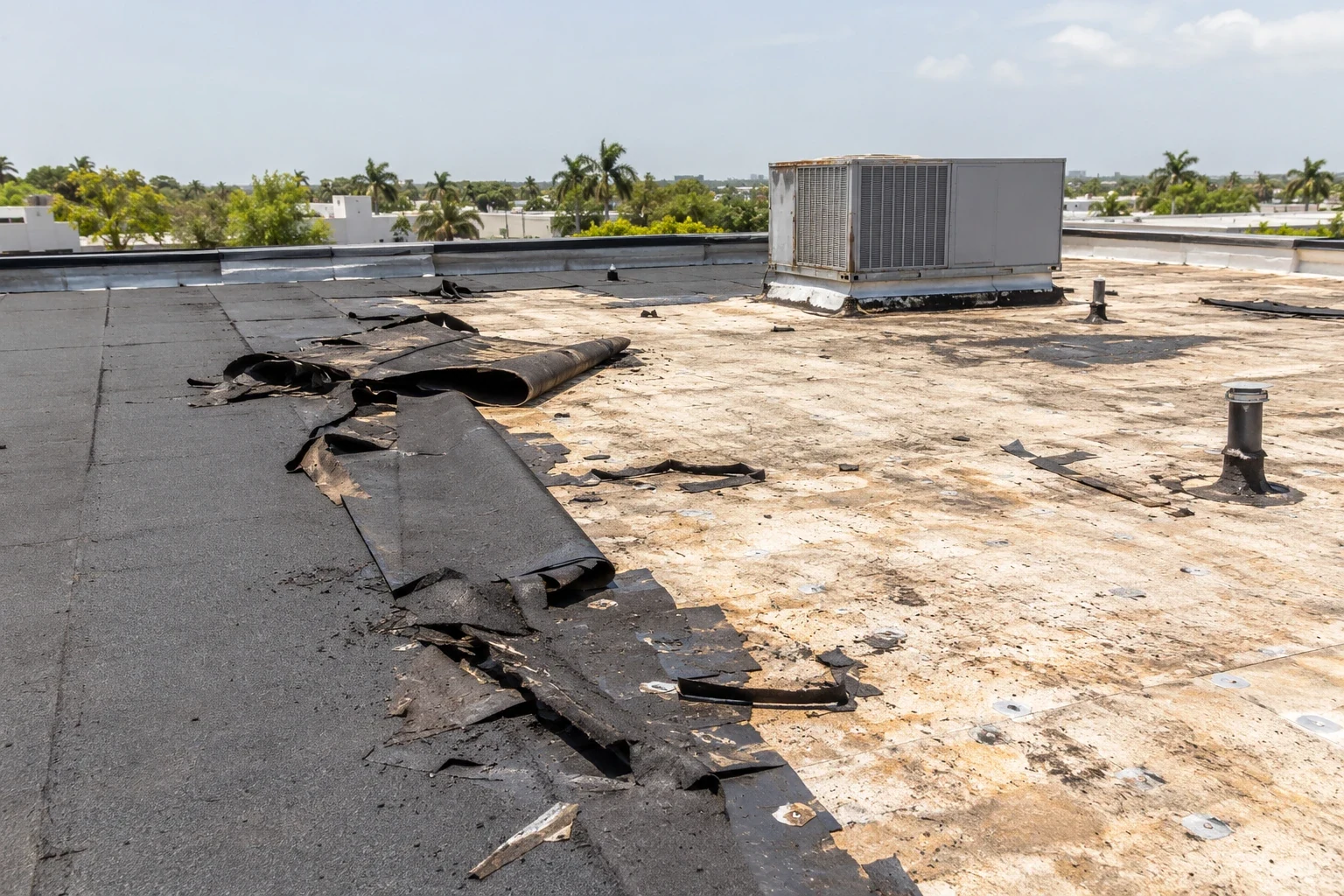
A roof is a stack of layers, and each one can hold or release moisture. The surface membrane sheds water, the insulation resists heat flow and the deck carries the load. When the membrane is breached, insulation soaks up water and loses its value, and the deck may begin to corrode if it is steel. That is why we separate a surface leak from a wet assembly before recommending anything.
On a roof with a smooth surface, we check seams and flashing by hand and by sight. Where the cause is unclear, a commercial roof inspection backed by a moisture survey tells us how far the water has spread. The result is a map with wet areas marked and a recommendation that matches the damage. A small wet patch can be cut out and replaced. A roof that is wet across most of its area is a candidate for replacement instead.
Repair, Recover, Coat or Replace
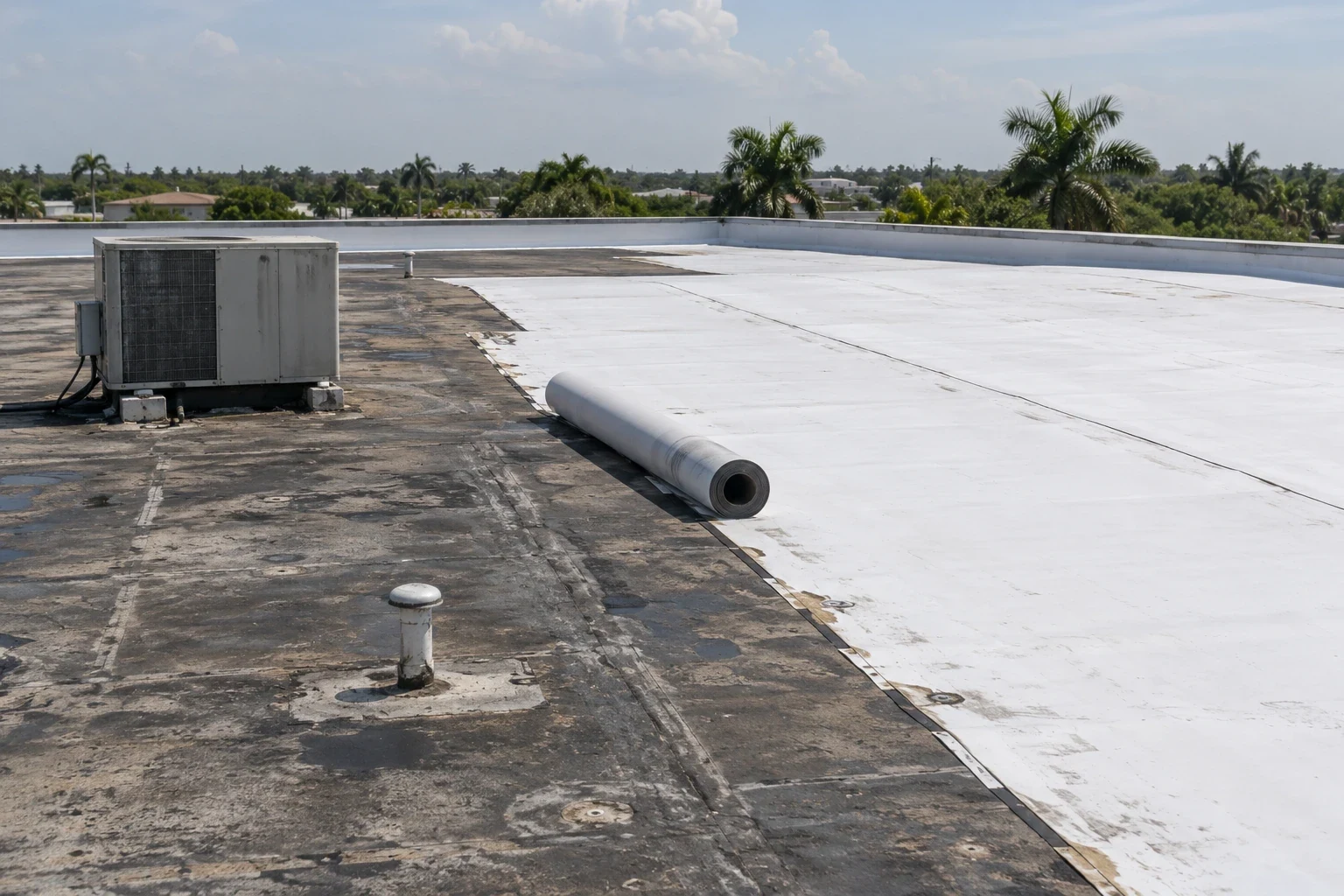
Four paths exist for most commercial roofs. A repair addresses a specific defect and works when the surrounding membrane is sound. A recover adds a new membrane over an existing one that is dry and well bonded. A coating renews the surface of a roof that is sound but weathered. Replacement removes the old system and starts over, which is the right choice when moisture has spread through the insulation or the deck has been damaged.
The price differences among these paths come from tear-off, disposal, insulation, access and the number of penetrations. We write each option with its scope, what it addresses and what it leaves alone, so a property manager can compare a short-term patch against a longer-term investment. Timing matters too, because heat and rain affect which adhesives and coatings can be applied.
Warranty and permit paperwork also shape the choice. A reroof needs a permit through the local building department, and the scope has to match what the code requires for the roof's wind resistance and drainage. Our written options note which items the permit covers, so the figure you compare is complete rather than a base price with extras added later.
Roofs and the Town Center Planning Vision
The City's adopted planning vision proposes a primary mixed-use Town Center around Bluesten Park and a future commuter-rail station on the FEC corridor. Plans like that influence how owners think about their buildings, because redevelopment can change use, height and tenant mix. A roof installed now should match the owner's likely holding period.
For a property that may be sold or reworked, a lower-cost system with a clear condition record gives a buyer confidence. For a building the owner will keep, a longer-life system with good insulation and drainage reduces maintenance calls. Either way, a written report with photos, roof sketches and moisture findings supports a sale, a lease renewal or a lender review. We prepare that report whether the job is a repair or a full replacement.
Preparing for the Roof Walk
Before we visit, gather what you have: past repair invoices, warranty paperwork, drawings and any photos of stains or standing water. Tell us which tenants report leaks and where. We arrange access with the property manager, check rooftop equipment ownership and walk the roof with safety gear. If the site is occupied, we plan the work around tenant hours and customer entrances.
If you own buildings in neighboring areas, we also work in Dania Beach and the Gateway East area of Hallandale Beach, and the same report format applies to each so you can compare roofs across a portfolio. Owners who want ongoing care can set up preventive maintenance visits tied to the wet season.
Related Roofing Topics