
Need this roof reviewed?
Plan apartment roof repair in Hollywood, FL around resident notices, shared drainage and safe access. Document leak paths and work zones before repairs begin.
A leak in one apartment can travel across a shared roof before it reaches a ceiling or wall. The property manager needs a path that connects the resident report with the roof detail, not a patch placed above the room by assumption. Hollywood, FL has heavy rain in June and September and considers tidal, surge and compound-flood exposure in its citywide planning. Nearby Hallandale Beach has its highest residential concentration along beachfront A1A, including tower settings. We inspect the actual roof, document drainage and transition conditions, and coordinate access so resident communication follows a defined work area.
Connect resident reports with roof locations
For each report, we record the unit or common area, date, weather and whether water is active or has stopped. We compare that information with the roof plan, drain layout, seams, parapets, balconies, equipment curbs and previous repair locations. Water may move under a membrane or across a deck before it appears indoors, so a stain can be offset from the opening. A marked photo and unit reference give maintenance staff a repeatable point for follow-up.
Where several roof details could explain the same report, we inspect each candidate and state what remains uncertain. If moisture may extend below the visible area, an inspection can define the next test. We do not infer the wet-area boundary from one interior mark. The owner receives a documented observation, a likely water path and the test or repair that would change the decision.
Multifamily properties may share a roof with retail, office or hospitality spaces. Where a hotel wing is part of the building, guest operations join the sequence, and a school next door brings fixed daily schedules that affect staging. For an apartment asset, resident notices, common-area protection and unit access shape the sequence.
Review shared outlets and overflow routes
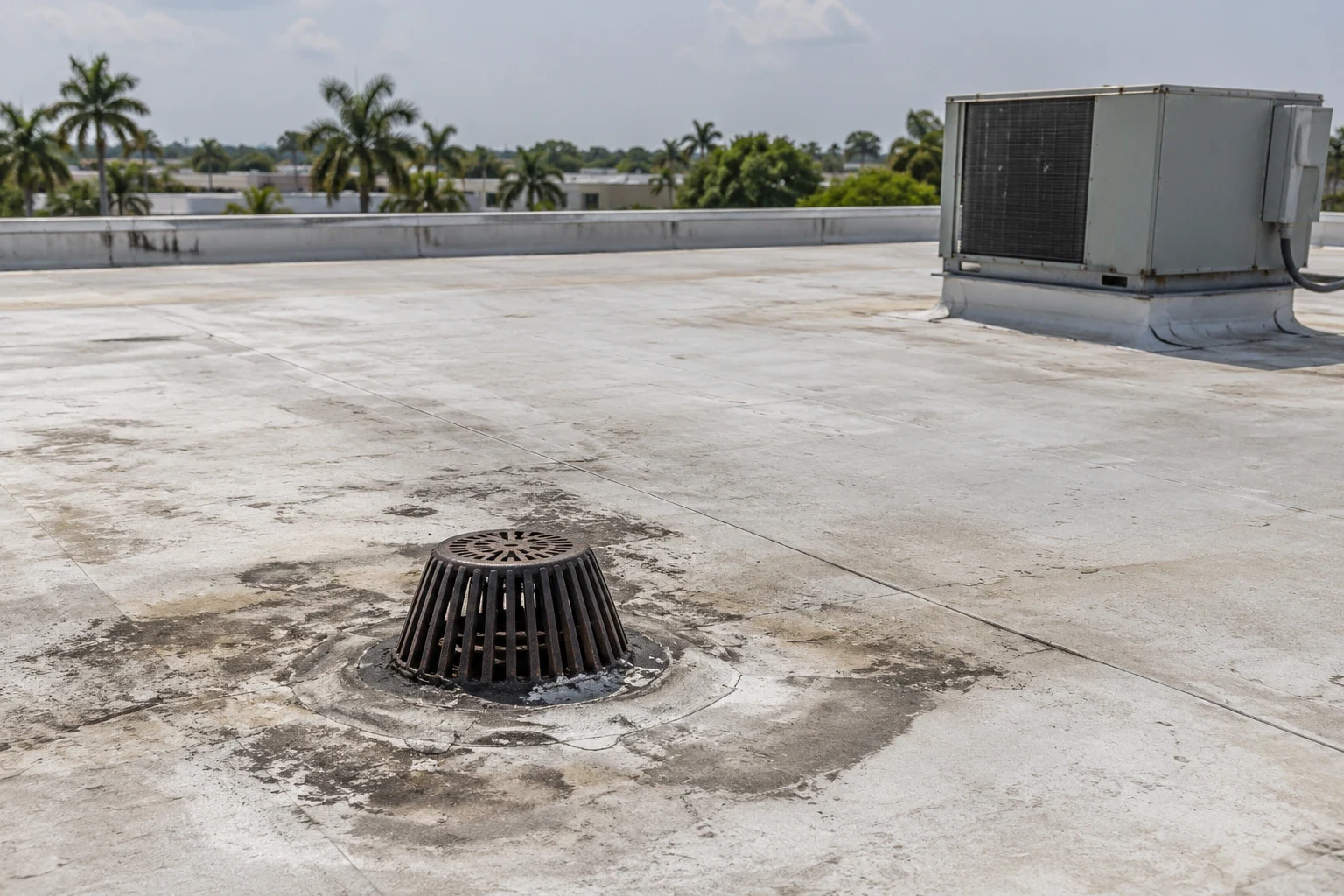
Apartment roofs can route water through drains that serve large shared fields. We inspect strainers, bowls, scuppers, overflow paths and the slope feeding each outlet. A clogged drain is not the only cause of ponding; settlement, a previous patch or a crushed insulation area can hold water even after the opening is cleared. We note water depth and duration where possible, then check nearby seams and walls for movement or repeated repairs.
Hollywood’s June and September precipitation averages each exceed eight inches. Those months are a useful time to ensure outlets and overflows are ready for heavy rain. A drain and scupper repair can address a damaged connection, while any membrane detail gets its own preparation and closeout record. The manager can then distinguish seasonal cleaning from construction work.
Flood designation and roof drainage are separate property records. Hollywood’s citywide assessment includes tidal flooding, storm surge and compound flooding among the risks considered. If a site also needs parcel elevation or flood-map review, we keep that question outside the roof condition report. The roof report records water movement across the assembly and at its penetrations, edges and drains.
Set work zones before notifying residents
Before mobilization, we confirm roof hatches, ladders, lift locations, material staging and any entry needed to inspect a unit or common room. A repair above a balcony may affect a different route from a drain repair near the service drive. We define the area, the expected duration and the property contact for changes in the field. That gives management a specific basis for resident notices instead of a broad warning with no work boundary.
Hallandale Beach’s beachfront A1A includes the city’s highest residential concentration. For a multifamily building in that broader area, access and resident coordination can be central to staging, but the building’s roof and ownership rules still need direct review. A multifamily building in Hallandale Beach, or one beside commercial activity in the Johnson Street Business District, gets the same defined work area, with delivery routes confirmed with the manager.
If an active leak reaches an occupied unit, emergency response is available around the clock, throughout the week and on holidays. We first coordinate safe entry and interior protection, then inspect the roof path. A temporary cover or patch is identified as interim work if a permanent repair must wait for suitable access or surface conditions. The property record should show when that return step is needed.
Compare a focused repair with broader work
A patch can be appropriate when the failed seam, flashing or penetration is isolated and surrounding material is sound. If wet insulation, loose attachment or repeated failures extend beyond that detail, a larger repair or replacement analysis may be warranted. We map confirmed conditions, record areas not opened and identify what testing could change the quantity. This helps ownership avoid pricing the whole roof from a single leak while retaining the option to broaden the scope if evidence supports it.
Cost and timing depend on membrane type, access, unit or common-area protection, the number of details, insulation removal, deck repair and resident coordination. A ponding-water repair review can clarify whether the cause is outlet capacity, slope or a membrane detail. If more than one building needs work, a multi-site roof program can standardize records while leaving each building’s condition distinct.
Hollywood’s Building Division handles construction permits and inspections, and the Florida Building Code 8th Edition became effective December 31, 2023. Where a reroof requires permits or design review, we coordinate the roofing scope with the owner’s project team. Field findings describe the observed assembly and work; they do not replace required plans or approvals.
Keep the roof record with property operations
After service, retain the repair location, photographs, materials, access limits, resident impact and follow-up item. Keep that record with leak logs, drain cleaning, equipment replacements and prior bids. When another unit reports water, the manager can compare dates and locations with the existing map. If the symptom returns at the same detail, the next visit can test whether the patch moved or moisture remained. A different location should be evaluated as its own path.
Hollywood’s Harrison and Tyler districts contain residential, commercial and mixed-use properties, with many buildings reflecting 1920s-era architectural styles. Styles like these are a reason to identify the system and materials from the roof itself, not from the facade. We document actual layers where confirmed and note when a test or opening is still needed.
Send the roof layout, unit reports, prior repair photos and access rules before scheduling a walk. We will inspect the relevant field and transitions, define a repair boundary and return a record the manager can use for resident communication and capital planning.
Related Roofing Topics