Need this roof reviewed?
Roof inspection and repair for flex and light-industrial buildings in Hollywood, FL: office-to-bay transitions, drainage, rooftop units, and moisture mapping.
A flex building is a roof with two personalities. Over the front office suite the field is usually quiet, with a few rooftop units and a short run to the drain. Over the rear bays the same membrane may carry exhaust fans, skylights, and a long slope toward a scupper. The wall between those two zones is where the moisture route often begins, because the membrane changes direction, the insulation thickness may change, and thermal movement works the joint twice a day. In Hollywood, FL, summer heat and heavy seasonal rain put that transition under repeated stress, and the first inspection has to follow the wetting pattern back to the water entry point before anyone prices a repair.
We inspect, repair, and recover roofs on flex and light-industrial buildings, and we begin with the layout of the building inside, because the interior stain rarely sits below the roof defect. A warehouse roof and the office roof of the same building often need two different findings, much as an office building roof does.
Office front and bay roofs under one membrane
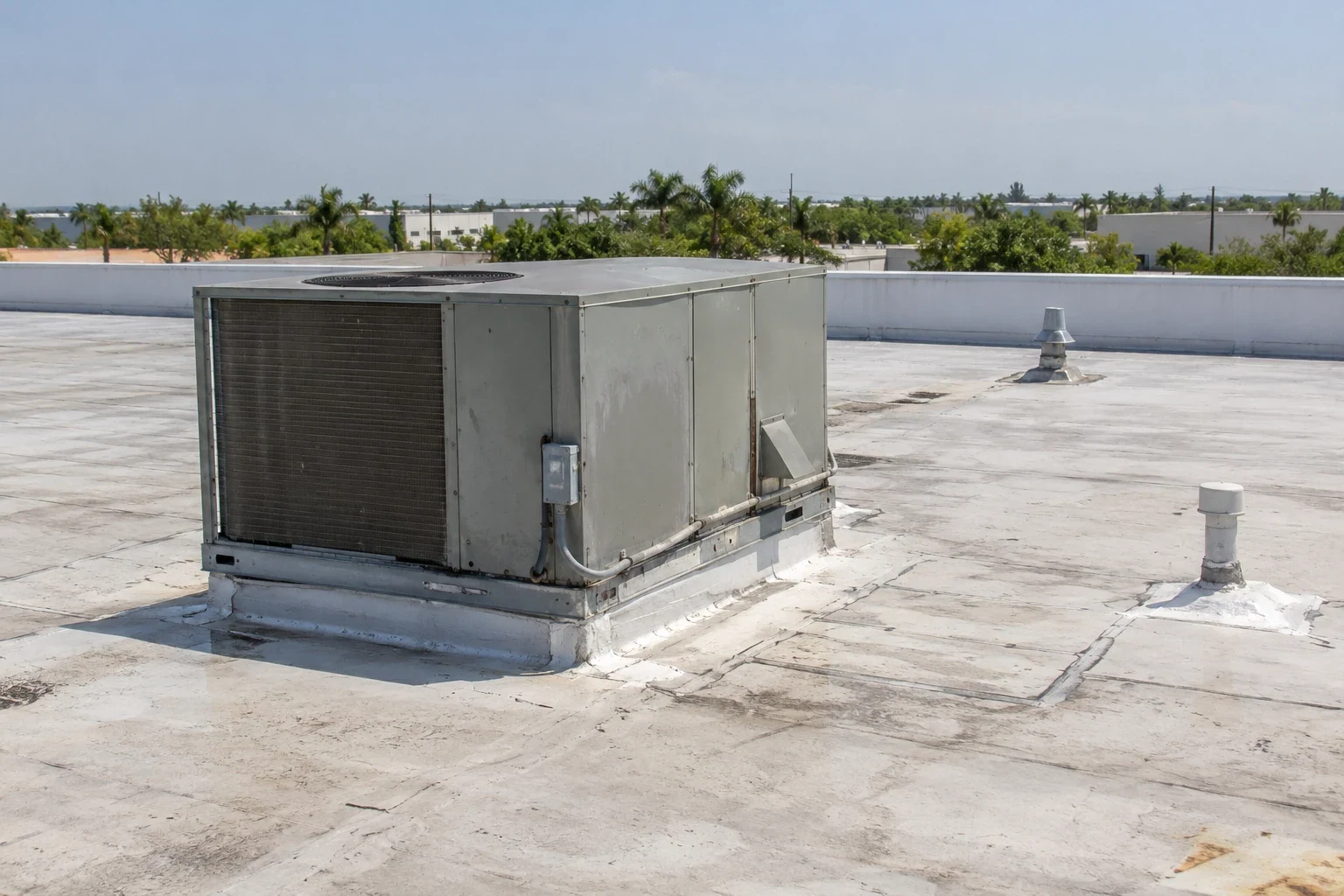
Flex space is sold as adaptable: a tenant can use it as showroom, light assembly, storage, or office. That flexibility shows up on the roof as a patchwork of additions. A kitchen exhaust from an office pantry, a spray-booth vent from a light-assembly tenant, and a cluster of condensing units added for a data closet can all appear on a roof that was originally laid out with few penetrations. Each one is a membrane transition that someone flashed at a different time with different materials.
On the first walk we count and map every penetration, note the flashing type at each, and check for abandoned openings. Hollywood identifies the Washington Park Industrial Area as a distinct area in a public planning and redevelopment process, and the Johnson Street Business District runs between 56th Avenue and US-441. Any multi-tenant flex building, in either area or elsewhere, can carry the same mix of changes over time, so we treat each roof as a record of what its tenants have asked it to carry, and we read that record before writing a scope.
Surface temperature and thermal movement
NOAA normals at the Hollywood station show an annual mean daily maximum of about 83 degrees and an August average daily maximum near 90 degrees. Those are air temperatures. A dark or aged membrane in direct sun runs far hotter than the air above it, and the difference between afternoon surface temperature and the overnight low is the thermal movement that opens seams, pulls flashings off curbs, and loosens termination bars.
That movement is greatest at transitions: where the membrane meets a parapet, where it turns up a curb, and where a bay section joins an office section at a different height. We look for the signs. A flashing that has pulled away shows a shadow gap along its top edge. A seam that has relaxed shows an open lap with dirt tracked into it. Exposed fasteners show rust halos. Reflective surfaces reduce the swing, and a cool roof can be an option when a replacement is already under review, but we describe the tradeoffs in insulation and drying potential before recommending it.
Rainy-season drainage and ponding depth
June and September normals at Hollywood each exceed eight and a half inches of rain, and South Florida's wet season turns stormiest in mid-May and stays that way into July. A flex roof with a few drains and a long slope moves a lot of water in a short window, and one blocked outlet turns a controlled run-off into a pond.
We measure ponding depth and duration, check the drain bowls and strainers, and see whether scuppers discharge freely onto a clear surface. Water standing against the membrane after a day without rain points to a drainage plane that is no longer working: a drain set high, a deck that has deflected, or insulation that has compressed. Cleaning is the first fix, and it is often enough. Where it is not, a tapered correction or a new outlet may be needed, and we price it as a separate item. Standing water that outlasts a day gets measured and logged on every visit, and the drains and scuppers are the first things we clear and test.
Wet insulation and the moisture route
Water that enters a flex roof at a rooftop unit curb can travel across the deck and surface above an office ceiling or a tenant's stock. The stain on the interior marks where the water came out, not where it came in. We compare ceiling marks with the roof plan, then scan the suspect area with infrared moisture mapping to see how far the wetting pattern extends. Cores confirm what the scan suggests.
The result is a moisture map that gives the owner a repair boundary. If the wet area is small and bounded, a local repair removes the saturated insulation and reflashes the entry point. If it spreads across several bays, the discussion turns to a recover or a replacement. We also record drying potential: some assemblies can dry through the deck, and others hold water between two impermeable layers. That detail decides whether a recover is safe or whether the old layers need to come off.
Tenant access and work sequencing
Flex buildings often have several tenants with different hours. A distribution tenant may load trucks at dawn, while an office tenant arrives at nine and a showroom opens at noon. Roof work is scheduled so material delivery and lift placement do not block dock doors or customer parking. We confirm who controls roof access, whether a ladder, a hatch, or a lift is needed, and which tenants sit under the work zone.
For work above occupied suites, we section the roof so each area is dried in by evening, protect openings with temporary membrane, and tell the affected tenants which days involve noisy steps. The property manager gets a single schedule for all tenants. A written condition report after the work records what was opened, dried, repaired, and left for later.
Repair, recover, or replace
The decision follows the findings. If the water entry is isolated, the insulation is dry, and the membrane has remaining life, a repair is reasonable. If the membrane is sound but tired, a coating restoration may extend service life. If insulation is widely wet or the assembly has been repaired many times, replacement is the likelier outcome. The Florida Building Code, 8th Edition (2023), became effective December 31, 2023, and Hollywood's Building Division checks reroof permits against it, so a replacement scope is confirmed with the city before it is final.
We lay out the options with cost drivers, not totals: access equipment, tear-off depth, insulation replacement, flashing complexity, and tenant coordination.
Related Roofing Topics