Need this roof reviewed?
Plan senior living roof repairs and replacement in Hollywood, FL, with protected resident areas, moisture mapping and phased work around care routines.
A drip above a resident corridor becomes an operating issue before it becomes a large roof opening. Senior living buildings need a roof scope that protects occupied rooms, dining areas and mechanical service while the leak path is traced. With June and September rainfall each topping eight inches in Hollywood, FL, drainage and transitions are the details to settle before another downpour finds the weak one. We inspect the assembly, map the moisture route and tell the property manager which area can be repaired now and which needs further confirmation.
Resident routines shape access
Roof access, lift placement and noise can affect residents, staff and visiting families. We identify occupied rooms below the work, medication and meal routines that cannot be interrupted, and exits that remain clear. The phase plan shows where materials arrive, which area opens and how the interior is protected. A controlled opening is safer for the building than treating the whole roof as one work zone. We identify a contact for field changes, confirm the route for emergency access and keep debris away from doors used by residents and staff.
Where a ceiling mark appears near a resident room, we compare its location with the roof plan, drains, curbs and seams above. Water may travel before it appears indoors, so the nearest penetration is not automatically the entry point. We record each observation and use selective openings when the assembly remains uncertain. A commercial roof inspection can set the condition baseline before repair, while an occupied-building sequence coordinates protection and communication with the facility team.
Moisture and indoor protection
Wet insulation can lose support and extend beyond the visible stain. We use a moisture survey to locate areas for confirmation, then inspect material depth through openings where needed. The report distinguishes affected board from layers that remain dry and serviceable. That removal boundary informs whether a patch, recover or replacement is appropriate and helps prevent a new membrane from covering a wet assembly.
In a care setting, immediate protection may come before a permanent repair can be completed. We coordinate catchment or temporary covering with staff, protect sensitive equipment and identify any room that needs a short restriction. The photo condition record locates the leak and the roof detail involved. A building with clinical functions borrows from medical office and hospital practice, though those uses do not share the same assembly.
Drainage after heavy rain
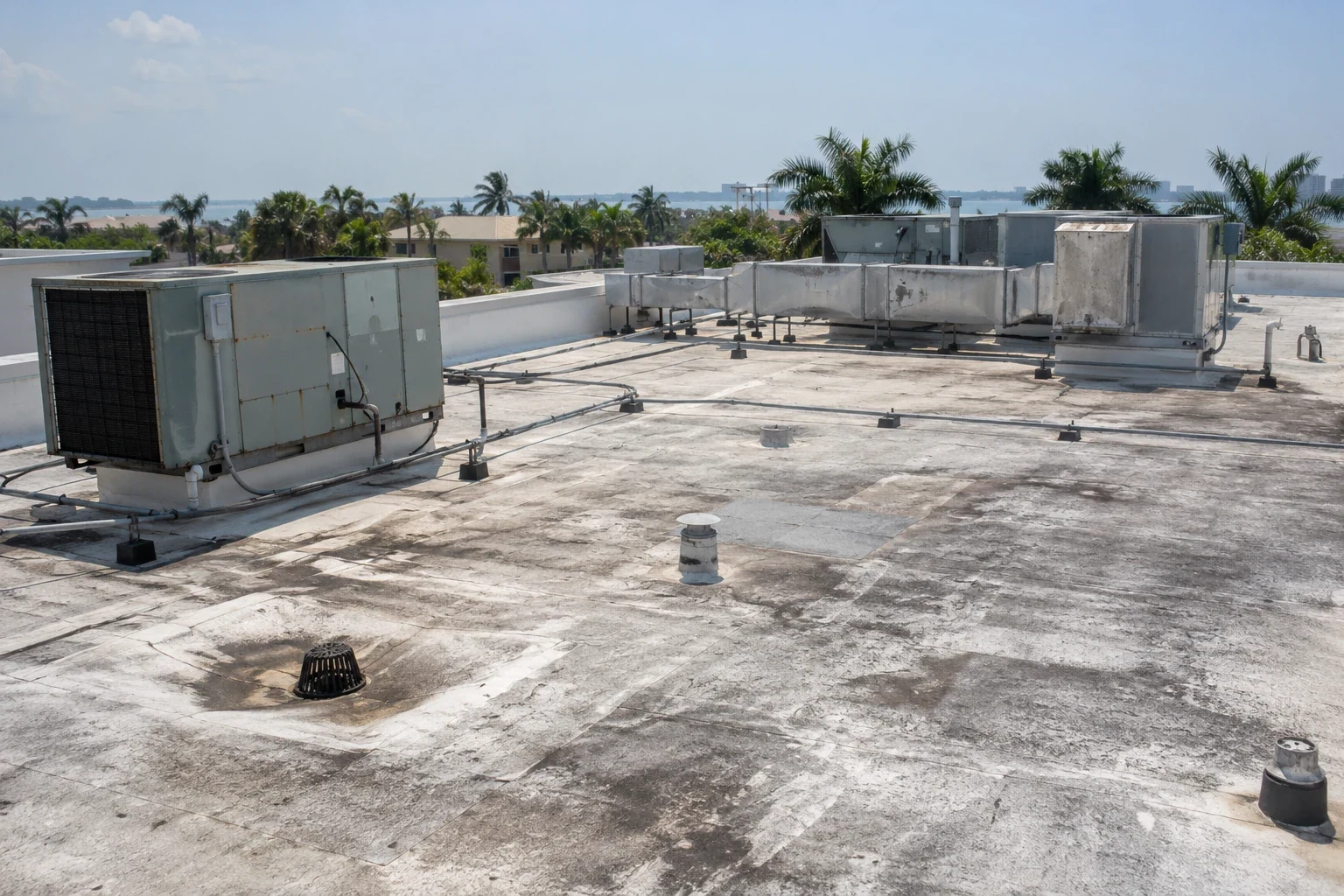
Drain bowls, overflow routes and surrounding membrane need a clear path after a downpour. We check strainers, sumps, scuppers and slope changes, then note whether a low area holds water beyond the expected drainage period. A blocked outlet calls for maintenance; a settled deck or incorrectly placed drain may require a broader correction. Each finding is tied to a location and an action.
Hollywood's stormwater program models rainfall together with tides as part of the city's flood-risk work. The citywide flood and climate material describes the city as a whole, so a senior-living roof is judged from its own walk-through. We keep rooftop drainage findings separate from ground-level flood planning, while the property manager can review current parcel and elevation requirements with the appropriate project team. The drain and scupper scope can identify outlet repairs before a larger replacement is priced.
Heat, membrane movement and timing
NOAA normals for Hollywood show an August average daily maximum of 89.9 degrees, a recurring heat exposure for roof surfaces. Temperature movement works on seams, flashing and sealant, while high humidity and rain affect the closure plan. We look for open laps, brittle material, separated curb flashing and repairs that have moved. Those observations, rather than the calendar alone, determine whether the roof needs a local correction or broader work.
Summer rainfall normals are higher in June and September, so material deliveries and exposed openings need a defined daily limit. We stage temporary protection before removal and close the area before leaving. If a storm is forecast, the sequence changes to secure the roof first. A TPO assembly or another membrane is selected only after the substrate and detail conditions are reviewed, not because one system is a universal fit.
Separate immediate repair from capital work
Senior living operators need a clear difference between emergency protection and a longer replacement plan. We identify the current leak, the moisture boundary and the repair that can restore service. If several areas show deterioration, we price the immediate correction separately from a phased capital scope. The owner can see which care areas need immediate attention and which roof zones can be scheduled later.
Hollywood identifies its Downtown and Beach business districts among its commercial settings, while the Johnson Street Business District is a separate local area. A senior community in Downtown Hollywood or the Johnson Street Business District still gets its own roof inspection, based on that building's access and operation. The budget recommendation documents quantities, access limits and conditions that could change after opening. A clear allowance lets ownership review the cost driver before concealed work is approved.
Leave the care team a usable record
Closeout should preserve the roof area repaired, materials installed, photographs and any follow-up observation. Staff can match a future ceiling report with the prior work location and tell us whether the same path has returned. A scheduled maintenance visit can check drains, seams and equipment transitions before a small defect spreads into resident space.
Emergency response runs day and night, weekends and holidays included. We first help protect the occupied area and then trace the roof condition that caused the leak. Share the room location, roof plan and care schedule. We will map the finding, explain the repair and identify a phased next step if the assembly needs more than a localized correction.
Related Roofing Topics